GHK-Cu Peptide: Skin, Hair, Benefits, Side Effects & What the Research Shows
A tiny copper-binding peptide, decades of fascinating research, and a community buzzing with stories about skin and hair. Pull up a chair, Peptide Cafe and Gary have plenty to say.
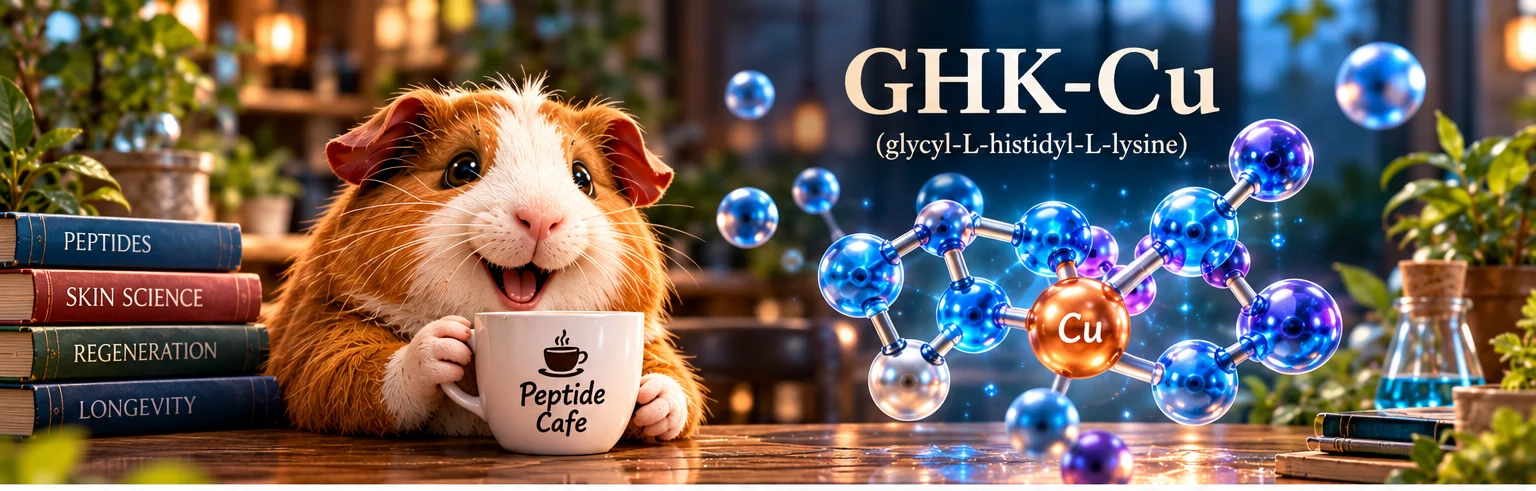
The molecule is conceptual, not a chemically accurate structural model.
GHK-Cu has become one of the most talked-about peptides in skincare and longevity conversations. Enthusiasts discuss smoother-looking skin, fine lines, scars and hair growth. Researchers have investigated related cellular processes for decades. So where do the science and those enthusiastic stories meet?
At Peptide Cafe, we’re excited by the possibilities. We also want to know exactly which results come from human trials, which come from laboratories, and which are personal accounts. All are interesting, but they answer different questions.
What is GHK-Cu?
GHK-Cu is a complex of copper and the naturally occurring tripeptide glycyl-L-histidyl-L-lysine (GHK). A tripeptide is simply a chain of three amino acids. GHK was identified in human plasma in the 1970s; subsequent research explored its copper-binding properties and possible roles in tissue biology.
Copper is a trace element involved in numerous biological processes. GHK’s ability to bind copper has made this combination interesting to scientists studying skin, connective tissue and cellular responses. The molecule’s biological activity, however, does not automatically establish that every product or method of administration will have a clinical benefit.
Background reading: Pickart & Margolina (2018).
Why scientists are excited about GHK-Cu
Research has examined how GHK-Cu interacts with fibroblasts, cells that help produce the structural material of connective tissue, as well as collagen-related processes, gene expression and inflammatory signalling. Laboratory and animal findings offer plausible reasons to investigate GHK-Cu for skin and tissue repair.
That breadth of biological interest is exciting. It also makes careful study design essential: a cell responding in a laboratory dish is not the same thing as a measured benefit in people.
Interested in how other molecules are being investigated in healthy-ageing research? Our NAD+ injections guide explores a different area of biology, along with the gap between popular wellness claims and human clinical evidence.
GHK-Cu for skin: wrinkles, texture and firmness
Skin appearance is the area most strongly associated with GHK-Cu. Some small human cosmetic investigations, often discussed in scientific reviews, have reported encouraging findings involving firmness, fine lines and skin quality. The challenge is that some widely repeated claims trace back to limited or incompletely reported studies, making their strength difficult to judge independently.
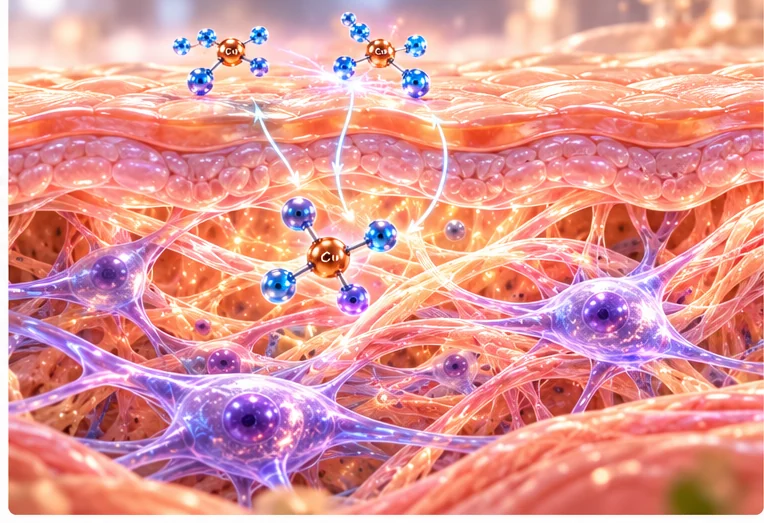
Conceptual skin-biology illustration, not a demonstrated clinical result or anatomical-scale diagram.
What did a controlled human study find?
In a 2006 study of 13 patients following CO₂ laser resurfacing, researchers found no statistically significant objective improvement in several measured skin outcomes with the topical copper-tripeptide regimen. However, participants reported greater improvement in overall skin quality. That distinction is important: the experience was encouraging to users, but objective evidence was mixed. See Miller and colleagues (2006).
The most accurate conclusion is that topical GHK-Cu has interesting preliminary cosmetic evidence, but larger, independently replicated studies are needed to quantify any reliable effects.
GHK-Cu before-and-after photos: what can they tell us?
It is easy to see why progress photographs attract attention. Visible changes in skin texture, wrinkles or hair are more relatable than laboratory measurements. But lighting, angle, expression, skincare routines and image editing can affect comparisons. Even authentic photographs do not isolate GHK-Cu from other influences.
We deliberately do not manufacture before-and-after images or present AI-generated faces as real treatment outcomes.
GHK-Cu and hair growth: what’s promising?
Hair growth is one of the most intriguing areas of interest. A laboratory study of the related but distinct peptide AHK-Cu examined human hair follicles in culture. That result should not be described as a clinical scalp-hair trial of GHK-Cu. See the AHK-Cu hair-follicle laboratory study.
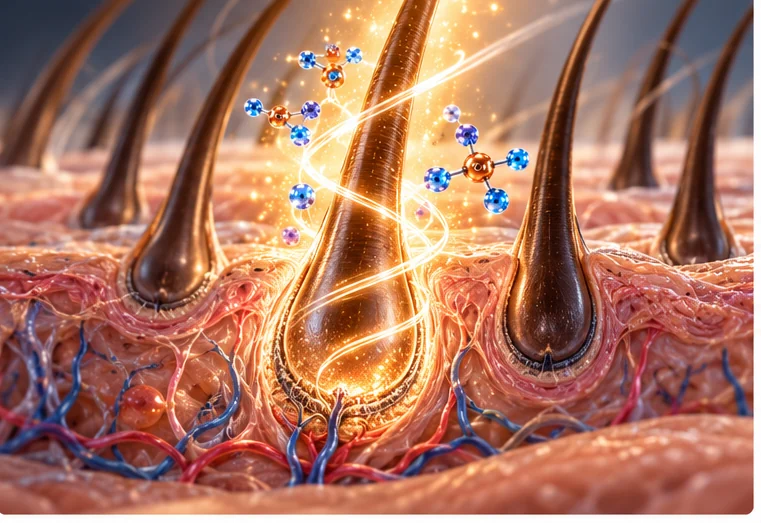
Conceptual hair-follicle illustration. It does not depict a proven hair-regrowth mechanism or treatment result.
A small human eyebrow study
A 2026 report described a randomised, double-blind split-eyebrow investigation in 18 adults over 12 weeks, comparing a topical 2% GHK-Cu serum with a placebo formulation. The authors reported improvements in eyebrow hair measurements on the treated side. It is an encouraging early human result, but the study was small and short. It does not establish scalp hair regrowth or benefits from injections.
Read the 2026 eyebrow study and the related university thesis; these relate to the same research programme and should not be counted as two independent trials.
GHK-Cu and wound healing
Laboratory and animal studies have investigated GHK-Cu in tissue repair, collagen-related processes and responses to injury. These findings help explain its long-running appeal in regenerative biology. They do not establish GHK-Cu as an effective human wound treatment.
For us, this is an exciting research direction and one where robust human trials would be especially valuable.
Side effects and safety: topical versus injectable
Topical products: Irritation or sensitivity is possible, including reactions to other ingredients in a cosmetic formula. Research on long-term use and different formulations is uneven.
Injectable GHK-Cu: This is a substantially different route of exposure. The US FDA has raised concerns about potential immunogenicity associated with aggregation and impurities in compounded injectable GHK-Cu, alongside limited human safety information. See the FDA safety information. These are US regulatory observations, not a statement of UK legal classification.
Personal reports of benefit, particularly from topical products, cannot establish the safety or effectiveness of injections. Peptide Cafe does not recommend suppliers, dosing or self-experimentation.
GHK-Cu evidence at a glance
| Area | Current picture |
|---|---|
| Skin appearance | Preliminary human cosmetic findings; mixed and limited |
| Collagen and cell activity | Mechanistic and laboratory evidence |
| Wound healing | Preclinical research; human efficacy not established |
| Eyebrow growth | One small controlled human study reported encouraging results |
| Scalp hair regrowth | Not established by robust human trials |
| Systemic anti-ageing | Hypotheses; clinical benefit not established |
| Injectable safety | Insufficient human data and identified concerns |

Guinea Pig Gary Has His Say 🐹☕
Real conversations, told with enthusiasm.
Oh, copper peptides! Now we're talking about those little everyday moments people absolutely LOVE describing. Smoother-looking skin, a fresher complexion and that delighted feeling when someone thinks their routine is making a difference and those are stories I'm happy to bring to the café!
In a public skincare discussion, a contributor said a copper-peptide product seemed to make a noticeable difference to their skin and redness. Importantly, they also said they were using plenty of other skincare products, so the change couldn't be isolated to copper peptides. In another discussion, someone who had tried different copper-peptide skincare products reported preferring the results from one topical formulation over another. These are personal impressions, not controlled comparisons.
And that is precisely what I find so interesting: people aren't always looking for spectacular transformations. Sometimes they are celebrating skin that looks calmer, texture they're happier with or small improvements they notice in the mirror. I think those positive experiences deserve to be heard alongside the science.
I must make one distinction: some reports refer broadly to copper-peptide products, not independently verified pure GHK-Cu, and topical skincare stories tell us nothing about injection safety. I'm Guinea Pig Gary, your enthusiastic reporter of the experience-led view, not a fictional patient claiming these things happened to me. And I'm cheering for more careful studies that explore the effects people are talking about!
Guinea Pig Gary is a fictional editorial character, not a person who used these substances. The linked posts are self-reported experiences, not verified testimonials or clinical evidence. References here do not endorse the products, suppliers or methods discussed in those posts.
☕ The Peptide Cafe Perspective
A tiny copper-binding peptide, decades of scientific curiosity and an exciting story that's still unfolding.
We think GHK-Cu is one of the most captivating peptides in the world of skin science and the more we explore its history, research and enthusiastic following, the more we understand why so many people are fascinated by it.
There's something wonderful about a naturally occurring molecule attracting scientific interest for decades.
GHK-Cu isn't simply a fashionable name appearing in modern skincare discussions. Researchers have been investigating GHK and its copper-binding properties since the 1970s, exploring how they might relate to connective tissue, cellular activity and the body's responses to damage.
That long scientific history makes GHK-Cu particularly interesting to us.
And the possibilities being investigated are genuinely exciting.
The skin research that gets us excited
Skin is where GHK-Cu has attracted some of its greatest attention, and it's easy to understand why.
Researchers have investigated how this copper-binding peptide interacts with fibroblasts, the cells responsible for producing important components of connective tissue.
Laboratory studies have explored collagen-related processes, tissue remodelling and cellular responses involved in maintaining and repairing skin.
We find this especially fascinating because collagen and connective tissue play such important roles in skin structure and appearance.
The idea that a small peptide could influence some of these biological processes is an exciting scientific question.
And importantly, the story doesn't end with laboratory experiments.
Small human cosmetic investigations have reported encouraging observations involving skin quality, firmness and the appearance of fine lines.
In a 2006 controlled study following laser resurfacing, participants using a copper-tripeptide regimen reported greater improvement in overall skin quality, even though several objective measures showed no statistically significant advantage.
We think that's an interesting result.
It highlights the difference between how people experience their skin and what researchers can demonstrate through clinical measurements.
The human evidence remains preliminary and mixed, but these findings provide worthwhile questions for larger, independent cosmetic studies.
The positive experiences are part of what makes this story so interesting
One of our favourite things about exploring GHK-Cu is the enthusiasm surrounding it.
In skincare conversations, people describe experiences involving smoother-looking skin, improved texture, a fresher complexion and fine lines that appear less noticeable.
Some contributors discuss skin that looks more hydrated or generally healthier.
And we can understand why those experiences generate so much interest.
For someone who enjoys skincare, even subtle changes in appearance can feel meaningful.
Not every positive experience needs to involve a dramatic transformation. Sometimes it's simply someone looking in the mirror and feeling happier with what they see.
We think those stories deserve a place in the conversation.
At the same time, skincare routines often involve multiple ingredients, changing environmental conditions and natural fluctuations in skin appearance.
That makes it difficult to establish whether GHK-Cu itself caused the improvements being described.
But positive user accounts can help researchers identify which cosmetic outcomes are most interesting to investigate.
And what about hair growth? Now that's intriguing!
Hair research adds another fascinating dimension to the GHK-Cu story.
Copper-binding peptides have attracted attention in experimental investigations involving hair follicles and biological processes related to hair growth.
A laboratory study involving the related but chemically distinct peptide AHK-Cu produced findings that helped stimulate interest in this area.
Those findings cannot automatically be attributed to GHK-Cu.
But in 2026, a small controlled human investigation brought GHK-Cu itself into the conversation.
In a randomised, double-blind split-eyebrow study involving 18 adults over 12 weeks, researchers compared a topical GHK-Cu serum with a placebo formulation.
The investigators reported encouraging improvements in eyebrow hair measurements on the treated side.
That's precisely the kind of early human research we love discovering.
It's a small, preliminary study, and eyebrow findings cannot establish that GHK-Cu reliably regrows scalp hair.
Nevertheless, a controlled human investigation reporting a positive signal gives scientists a reason to explore this question further.
We'd be particularly excited to see larger trials investigating different hair-related outcomes.
A fascinating future for skin and tissue research
Another aspect of GHK-Cu that captures our imagination is its broader connection with tissue biology.
Experimental studies have explored processes involving collagen, cellular repair responses and wound-related biology.
These are important scientific subjects, with potential implications for understanding how tissues maintain and repair themselves.
We should be careful not to confuse encouraging laboratory or animal findings with proven human wound-healing treatments.
Yet the research remains an intriguing foundation for future investigation.
Could scientists identify specific biological effects that translate into measurable improvements in people?
Might larger cosmetic trials establish whether GHK-Cu provides consistent improvements in skin appearance?
Could controlled studies clarify its possible role in eyebrow or scalp-hair research?
And might researchers develop a clearer picture of which formulations are effective and which approaches carry unacceptable risks?
These are exciting questions, and we can't wait to see how the evidence develops.
An important distinction between skincare and injections
One reason we value careful research is that GHK-Cu is discussed in very different contexts.
Topical cosmetic preparations and injectable substances are not interchangeable.
The encouraging cosmetic observations associated with topical preparations cannot establish that injecting GHK-Cu is beneficial or safe.
Human safety information for injectable GHK-Cu remains limited, and the US FDA has identified concerns involving certain compounded preparations, including potential immune reactions associated with aggregation and impurities.
We can be tremendously enthusiastic about GHK-Cu's scientific possibilities while recognising that different formulations and routes of exposure require their own evidence.
For us, that makes high-quality research even more valuable.
Imagine what the next generation of research could discover
What excites us most about GHK-Cu is that it brings together several fascinating areas of investigation.
We have a naturally occurring peptide with a long research history.
We have laboratory findings exploring important processes in skin and connective tissue.
We have preliminary human cosmetic observations, including a small controlled eyebrow study.
And we have an enthusiastic community discussing the changes people believe they've experienced.
That combination makes GHK-Cu a wonderfully interesting subject for continued research.
We're optimistic about the questions scientists can now explore, particularly through larger, independently replicated human trials.
✨ What makes GHK-Cu so exciting?
- Fascinating skin and collagen researchLaboratory findings and preliminary cosmetic studies offer intriguing questions about skin appearance and connective-tissue biology.
- Enthusiastic skincare experiencesPeople describe positive changes in skin texture, fine lines and complexion, providing interesting themes for future investigation.
- Encouraging early eyebrow researchA small controlled human study reported positive eyebrow-hair findings that deserve further testing.
- Decades of scientific investigationGHK-Cu continues to inspire research into tissue biology, cellular processes and possible cosmetic applications.
- A future full of research possibilitiesBetter-controlled studies could reveal which proposed benefits are genuine, reproducible and clinically meaningful.
Our verdict? GHK-Cu is a wonderfully intriguing peptide with a rich scientific history, fascinating skin and connective-tissue research, encouraging preliminary cosmetic findings and a passionate community sharing its experiences. The early eyebrow research adds another exciting chapter. We're genuinely enthusiastic about its potential as a subject for further investigation, and we look forward to seeing what larger human studies reveal.
Science, experiences, claims and curiosity are all welcome at the Peptide Cafe. ☕
Frequently asked questions
Does GHK-Cu work?
That depends on the outcome and formulation. There is preliminary human cosmetic evidence and a small positive eyebrow study, but not every popular claim has been demonstrated clinically.
Can GHK-Cu reduce wrinkles?
Some preliminary cosmetic findings are encouraging, while controlled results have also been mixed. Larger independent studies are needed.
Can GHK-Cu regrow scalp hair?
Scalp regrowth has not been established by convincing human trials. Eyebrow findings are promising but not interchangeable with scalp results.
How quickly does it work?
There is no reliable universal timeframe. Online accounts and studies use different formulations, outcomes and observation periods.
Is GHK-Cu safe to inject?
Human safety evidence is insufficient, and regulators have highlighted concerns about compounded injectable preparations.
Are before-and-after pictures proof?
They can illustrate an individual's reported experience, but cannot establish causation without controlled comparisons.
Original research & further reading
- Pickart & Margolina (2018), review of proposed regenerative and protective actions.
- Miller and colleagues (2006) — small randomised human study following laser resurfacing.
- 2026 eyebrow study — controlled eyebrow investigation.
- related university thesis — related thesis; not a separate independent trial.
- AHK-Cu hair-follicle laboratory study — related peptide, laboratory hair-follicle work.
- FDA safety information, concerns involving certain compounded injectable substances.
Editorial note: This independent educational guide distinguishes published findings, preliminary hypotheses and anecdotal reports. It is not medical advice, a product recommendation or encouragement to use experimental substances. UK regulatory status should be checked against current MHRA requirements before making specific legal claims.