PEPTIGRAM – The Human Body Peptide Map
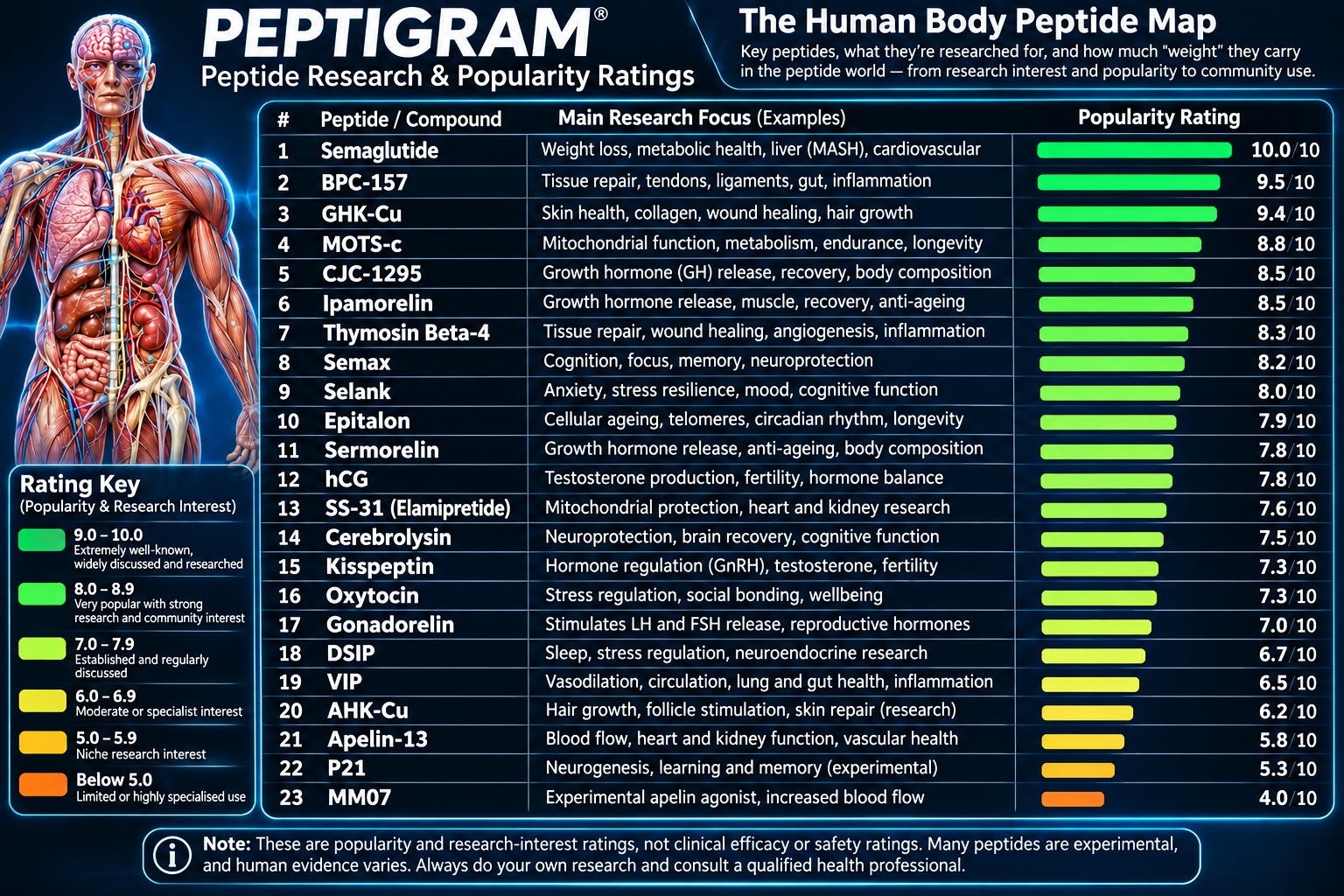
Explore a visual map of 23 peptide compounds and the body systems being investigated, alongside popularity rankings and a personal look at cardiovascular, endurance and longevity research.
Curious about peptides? You’re in good company. Explore the research, the claims and the conversations people are having — all in plain English, with no sales pitch.
THE CAFÉ MENU
Whether you're brand new or following a particular peptide, there's a seat for you here. Pick a place to start.
Explore our in-depth guides and featured illustrated article, served with research, real-world claims and a healthy helping of curiosity.
Explore a visual map of 23 peptide compounds and the body systems being investigated, alongside popularity rankings and a personal look at cardiovascular, endurance and longevity research.
A plain-English, illustrated journey through seven peptide characters and the roles researchers propose they play in the body's remarkable factory.

Why is BPC-157 attracting so much attention? Explore the animal research, early human evidence, recovery claims and the questions still unanswered.
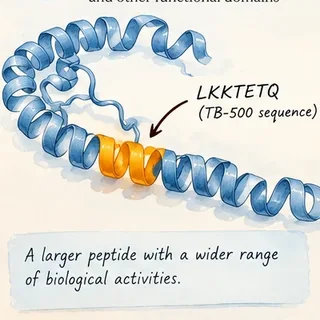
Discover why TB-500 is discussed alongside thymosin beta-4, what laboratory and animal studies suggest, and why human injury-recovery claims remain unproven.
Explore the remarkable weight-loss findings from human trials, how its three hormone receptors work, potential wider effects and important unanswered questions.
Explore the science behind Mounjaro, its weight-loss trial results, real-world experiences, side effects and what UK guidance says.

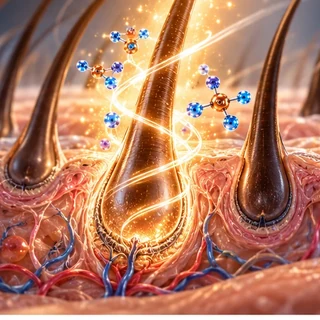
Meet the copper peptide sparking conversations about skin, collagen and hair. Explore early human research, popular experiences and what remains unproven.
Explore the mitochondrial peptide behind energy, endurance and longevity claims, from intriguing animal studies to human research and real-world experiences.
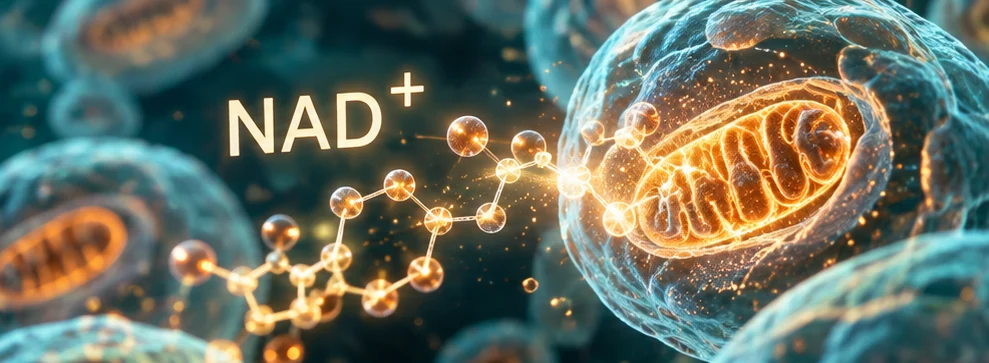
Can NAD+ injections really help with energy, mental clarity and healthy ageing? Explore the claims, personal experiences and what human research has — and hasn't — established.
Can this four-amino-acid peptide influence cellular ageing? Explore the telomere experiments, sleep-related experiences and limits of human evidence.
Why do people combine BPC-157 and TB-500? Explore encouraging recovery reports, the science behind the pairing and what research can actually tell us.

More guides are brewing. Anything marked Coming soon isn't published yet.
What can we get you? Pick what you're interested in to see which peptides have been studied for it, and how strong the evidence really is.
This is where peptide science is strongest. GLP-1 medicines copy a gut hormone that signals fullness and slows digestion, and large trials have shown meaningful weight loss. In the UK they are prescription-only.
Peptides are some of the most common ingredients in serums and creams. Lab results are promising, but most human trials are small and often funded by the companies that make the ingredients.
Anti-ageing is where claims run furthest ahead of the evidence. Collagen peptides have the most human data, mostly on skin elasticity and hydration. Longevity peptides such as epitalon rest on far thinner research.
Growth hormone secretagogues such as ipamorelin and CJC-1295 are widely discussed online, but there is little good human evidence that they build muscle. Collagen peptides taken alongside resistance training have shown small gains in some trials.
Growth hormone secretagogues are banned in sport under anti-doping rules, in and out of competition.
BPC-157 and TB-500 are the names you'll see most. Nearly all of the research on them is in animals, and neither is a licensed medicine in the UK.
Peptide hair serums usually contain copper peptides or biotinoyl tripeptide-1. Evidence in people is limited to small studies. For hair loss, a GP or dermatologist can tell you about treatments with stronger evidence.
Two peptide medicines are licensed in the UK for gut conditions: linaclotide for IBS with constipation, and teduglutide for short bowel syndrome. BPC-157 and KPV are popular online but have mostly been studied in animals.
Teriparatide, a fragment of parathyroid hormone, is a licensed peptide treatment for osteoporosis. Collagen peptides for joint pain have produced mixed results across trials.
Selank and Semax are registered medicines in Russia but not in the UK, and most studies on them come from Russian research groups. DSIP has been studied for decades with inconsistent results.
Thymosin alpha-1 is licensed in some countries outside the UK, mainly for hepatitis B. LL-37 is one of the body's own antimicrobial peptides and has mostly been studied in the lab.
Peptides are short chains of amino acids joined by peptide bonds. A chain of roughly 2 to 50 amino acids is usually called a peptide; longer chains that fold into stable shapes are proteins. In the body, peptides act as hormones, signals and defences against microbes. In medicine, they include GLP-1 drugs such as semaglutide.
Most peptides work by fitting into receptors on the surface of cells, a little like a key in a lock. When a peptide binds, the cell responds: releasing insulin, slowing digestion, or signalling fullness to the brain.
The effect is usually short-lived, because enzymes called peptidases break peptides down within minutes to hours. Drug makers get around this by changing the structure. Semaglutide, for example, carries a fatty-acid chain that lets it bind to albumin in the blood, so a single dose lasts about a week.
| Peptides | Proteins | |
|---|---|---|
| Length | Roughly 2 to 50 amino acids | Usually more than 50 amino acids |
| Shape | Often flexible | Fold into stable 3D structures |
| Examples | Oxytocin, glucagon, GHK-Cu | Haemoglobin, collagen, antibodies |
Health information online is full of sales pages dressed up as guides. These are the rules we hold ourselves to.
Peptides are short chains of amino acids, the same building blocks that make up proteins. Most definitions count a chain of roughly 2 to 50 amino acids as a peptide. Your body makes many of them, and a lot of them work as messengers that carry signals between cells. Oxytocin, glucagon and GLP-1 are all peptides.
Length and shape. Peptides are short chains, usually under about 50 amino acids, and are often flexible. Proteins are longer chains that fold into stable three-dimensional structures, like the haemoglobin in your blood or the collagen in your skin. The cut-off is a convention rather than a hard rule.
It depends on the product and how it is sold. Licensed peptide medicines, such as semaglutide (Wegovy) and tirzepatide (Mounjaro), are prescription-only medicines regulated by the MHRA. Most unlicensed peptides are not controlled drugs, but selling or supplying a product as a medicine for people without the right authorisation can break UK medicines law. This is general information, not legal advice.
There is no single answer, because peptides range from tested medicines to untested lab chemicals. Licensed peptide medicines have been through clinical trials and come with known side effects. Unlicensed peptides sold online have no guarantee of what is in the vial, and most have little or no human safety data. Speak to a GP or pharmacist before using any peptide product.
No. Steroids are a different class of molecule, built around a four-ring carbon structure, and the body makes its own steroid hormones from cholesterol. Peptides are chains of amino acids. The two can affect some of the same body systems, but they are chemically unrelated.
Usually not effectively. Digestive enzymes break most peptides down before they reach the bloodstream, which is why many peptide medicines are injected. There are exceptions: oral semaglutide (Rybelsus) uses an absorption enhancer, and collagen peptides are taken as a food supplement, though much of what you swallow is digested like any other protein.
Pull up another chair ☕
Curious about new peptide research, the claims people make and the experiences they share? Our Telegram group is a welcoming place to exchange ideas and ask questions. Independent discussion, with no sales or supplier links.