What if some of the most interesting secrets of healthy ageing were hiding inside the microscopic structures that supply our cells with energy?
That's the fascinating possibility behind MOTS-c.
For years, scientists viewed mitochondria primarily as the cellular machinery responsible for producing usable energy. But researchers have discovered that these tiny structures do much more than keep the lights on.
They can also participate in communication between different parts of the cell, helping coordinate responses to stress, metabolism and changes in energy availability.
And among the molecules involved in this remarkable biology is a peptide called MOTS-c.
Since its identification in 2015, MOTS-c has attracted interest among researchers investigating metabolism, exercise, insulin sensitivity and age-related physical decline.
Outside the laboratory, the conversation has grown even more ambitious.
People are discussing MOTS-c in connection with improved stamina, greater energy, fat loss, recovery, metabolic health and longevity.
Some enthusiasts have shared striking personal accounts. And some animal experiments really are intriguing.
But what has science actually demonstrated? Why do people believe MOTS-c could be important? And how much of the excitement is supported by human research?
Pull up a chair. This is a particularly fascinating one.
What exactly is MOTS-c?
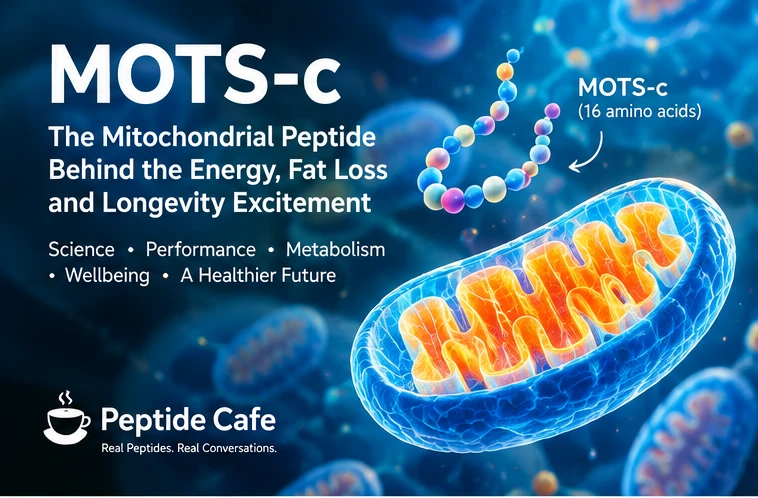
MOTS-c is a naturally occurring peptide consisting of just 16 amino acids.
Its name comes from mitochondrial open reading frame of the 12S rRNA-c. That's quite a mouthful, so we'll stick with MOTS-c.
What makes it unusual is its genetic origin.
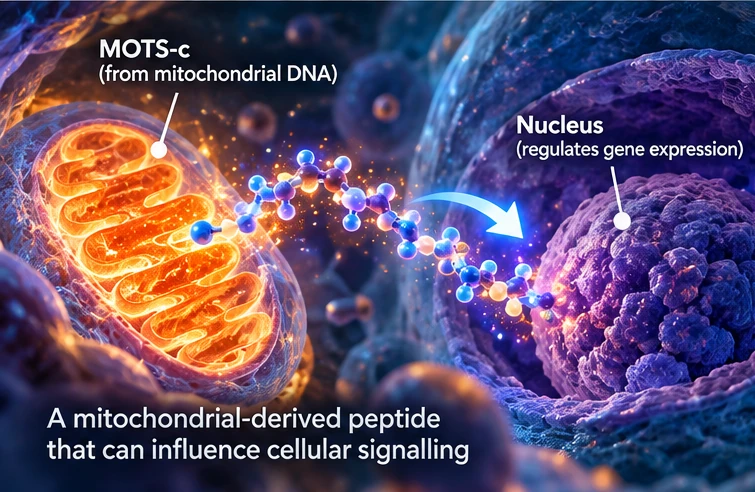
Most of the body's proteins are encoded by DNA housed in the cell's nucleus. MOTS-c, however, is encoded within mitochondrial DNA.
Mitochondria contain their own small genome, a fascinating inheritance from their ancient evolutionary origins.
Scientists have discovered that this genome contains more biologically interesting information than was once appreciated.
MOTS-c belongs to a family of molecules known as mitochondrial-derived peptides, alongside other intriguing examples such as humanin.
Rather than simply contributing to energy production, these peptides appear to participate in signalling processes that influence how cells respond to metabolic conditions.
That opens up a remarkable scientific question.
Could mitochondria help coordinate the body's response to energy shortages, exercise and ageing by sending peptide-based messages?
MOTS-c has given researchers a compelling reason to investigate.
Why are people so excited about MOTS-c?
The excitement comes from three overlapping areas.
First, researchers have reported improvements in metabolism and insulin sensitivity in experimental models.
Second, animal studies suggest MOTS-c can influence physical performance and some aspects of age-related decline.
Third, people discussing their own experiences online have described perceived improvements in energy, endurance, recovery and general wellbeing.
Put those together and it's easy to understand the attraction.
For someone interested in running, cycling or gym performance, the possibility of improving the body's metabolic response to physical activity is fascinating.
For someone interested in weight management, the findings involving insulin sensitivity and diet-induced obesity are particularly appealing.
And for anyone curious about longevity, the suggestion that a mitochondria-derived peptide could influence aspects of ageing-related biology is difficult to ignore.
But these are not all established human benefits.
The positive animal experiments, human observations and personal claims need to be considered separately. That's where the story becomes much more interesting.
The science behind MOTS-c: a message from our mitochondria
AMPK: the body’s cellular energy sensor
MOTS-c is particularly interesting because of its relationship with the body's energy-sensing systems.
One of the important pathways researchers have investigated is known as AMPK, short for AMP-activated protein kinase.
It's an enzyme involved in helping cells respond when energy availability changes.
Imagine a busy café. When supplies are plentiful, everything runs normally. But when resources become limited, somebody needs to notice and adjust how things are being used.
AMPK helps cells respond to changes in their energy status, influencing pathways involved in glucose use, energy production and metabolic adaptation.
In the original 2015 MOTS-c research, scientists found that the peptide affected pathways connected with folate metabolism and purine synthesis, leading to AMPK activation under experimental conditions.
These findings offered a possible explanation for some of the metabolic effects observed in laboratory and animal experiments.
And they suggested that MOTS-c was doing something more sophisticated than simply increasing the production of energy. It appeared to influence how cells responded to metabolic challenges.
A peptide that can communicate with the cell’s nucleus
Then came another fascinating discovery.
In 2018, researchers reported that MOTS-c could move into the nucleus of cells in response to metabolic stress.
That's particularly remarkable because the peptide originates from the mitochondrial genome.
The experiments suggested it could participate in regulating nuclear gene expression and cellular stress responses.
In other words, researchers were investigating a form of communication between two important genetic systems inside the same cell.
It's an extraordinary piece of biology.
But these experiments mainly concern molecular mechanisms and laboratory models. They do not establish that administering MOTS-c improves health or longevity in humans.
Original research: Kim and colleagues, Cell Metabolism (2018).
The 2015 discovery that started the excitement
One of the most important MOTS-c papers appeared in Cell Metabolism in 2015.
Researchers led by Changhan Lee investigated whether this newly identified mitochondrial peptide could influence metabolic regulation.
The findings were intriguing.
In experimental systems, MOTS-c influenced processes associated with glucose metabolism and insulin sensitivity.
In mice, treatment helped protect against certain metabolic changes associated with ageing and high-fat feeding.
The researchers also reported protection against diet-induced obesity under the conditions studied.
For anyone interested in metabolic biology, these were noteworthy results.
They suggested that a tiny peptide encoded by mitochondrial DNA could influence processes associated with whole-body energy regulation.
But there's an important limitation.
These findings came from laboratory and animal experiments, not clinical trials showing that MOTS-c produces weight loss or improves diabetes outcomes in humans.
The study provides a scientific foundation for further investigation, rather than proof of an established therapy.
Original research: Lee and colleagues, Cell Metabolism (2015).
MOTS-c and exercise: where things get really interesting

If one area of MOTS-c research deserves particular attention, it's physical performance.
In 2021, scientists published a study in Nature Communications investigating MOTS-c, exercise and age-related physical decline. And the results opened up some fascinating questions.
What happened in the mouse experiments?
Researchers investigated MOTS-c in young, middle-aged and older mice.
They reported improvements in physical performance following experimental treatment.
Some of the findings involved running capacity, skeletal-muscle metabolism and responses to metabolic stress.
Particularly interesting were experiments involving very old mice.
When treatment began late in life, researchers observed improvements in physical capacity and certain measures associated with healthspan.
Healthspan refers to the period of life spent in relatively good health and functional ability, rather than simply the total number of years lived.
The study did not demonstrate that MOTS-c extends human lifespan.
But it did raise fascinating questions about whether mitochondrial signalling could influence some aspects of age-related physical decline.
What did the researchers find in humans?
This is where we need to separate two very different findings.
The researchers also investigated naturally occurring MOTS-c in healthy young men undergoing an exercise challenge.
They reported increased MOTS-c levels in skeletal muscle following exercise, as well as increases in circulating MOTS-c during and shortly after exercise.
In the experiment, relative skeletal-muscle MOTS-c levels increased approximately 11.9-fold following exercise, while circulating levels increased approximately 1.6-fold during exercise and 1.5-fold afterwards.
These are measurements of the body's own MOTS-c response.
They are not evidence that administering synthetic MOTS-c improves human exercise performance.
Nevertheless, they're scientifically exciting.
They suggest that MOTS-c may participate in the body's natural response to physical activity, and they provide another reason why researchers are interested in the relationship between mitochondrial signalling, exercise and ageing.
Original research: Reynolds and colleagues, Nature Communications (2021).
Can MOTS-c improve energy and endurance?
This is probably one of the questions that brings the greatest number of curious visitors into the MOTS-c conversation.
And the answer depends on what kind of evidence we're discussing.
In mice, controlled experiments have demonstrated improvements in physical performance under specific conditions.
In humans, researchers have measured changes in naturally occurring MOTS-c during exercise.
And in online peptide communities, some people report feeling more energetic, improving running performance or finding exercise less exhausting.
Those three observations are interesting when considered together. But they don't establish the same conclusion.
At present, sufficiently robust human clinical evidence demonstrating that administered MOTS-c improves endurance, stamina or exercise recovery is lacking.
That doesn't make the animal findings uninteresting. It means researchers still have an important question to answer.
Could the effects observed in experimental models eventually translate into meaningful improvements in people?
For now, it's a possibility worth investigating rather than a demonstrated clinical benefit.
MOTS-c and fat loss: what does the research suggest?
Another major area of interest is weight management.
The original animal research reported protection against diet-induced obesity and improvements in measures associated with metabolic regulation.
Naturally, this has attracted attention among people interested in fat loss and body composition.
But the relationship between cellular metabolism and human weight loss is complicated.
A substance that changes insulin sensitivity or metabolic signalling in mice does not necessarily produce meaningful fat loss in people.
Human body weight is influenced by appetite, energy intake, physical activity, physiology, medications, health conditions and numerous other factors.
There's also an important distinction between MOTS-c and established weight-management medicines.
Unlike tirzepatide and retatrutide, which have been investigated in substantial human weight-management trials, MOTS-c lacks comparable clinical evidence demonstrating weight-loss effectiveness.
The metabolic research is interesting.
But claims that MOTS-c reliably burns human body fat, dramatically changes body composition or produces clinically meaningful weight loss remain unproven.
MOTS-c and insulin sensitivity: an intriguing scientific connection

One particularly promising area of the early research concerns insulin sensitivity.
Insulin helps regulate how the body handles glucose. When tissues become less responsive to insulin, maintaining healthy blood glucose levels becomes more difficult.
In mouse experiments, MOTS-c influenced metabolic processes associated with insulin responsiveness.
The results suggested that mitochondrial-derived peptides might help scientists explore new aspects of metabolic regulation.
That's a worthwhile discovery.
But we shouldn't jump from improved insulin sensitivity in mice to claims that MOTS-c treats insulin resistance or diabetes in humans.
Those are much bigger clinical questions.
Well-designed human trials would need to establish whether administered MOTS-c produces reproducible benefits, in whom, at what level of risk and for how long.
Until then, the findings remain promising experimental biology.
Could MOTS-c influence ageing and longevity?
Now we're entering one of the most fascinating areas of the entire MOTS-c story.
Ageing involves changes across many biological systems.
Mitochondrial function, metabolic regulation, cellular stress responses and muscle performance are among the processes scientists investigate when studying age-related decline.
MOTS-c sits at the intersection of several of these subjects.
Another topic in the wider conversation about cellular energy and ageing is NAD+ injections and the research behind their wellness claims. NAD+ is a coenzyme, not a peptide, and findings about NAD+ cannot be taken as evidence of MOTS-c benefits. Both topics raise interesting but distinct scientific questions.
Its ability to influence metabolic signalling and gene expression under experimental conditions makes it an intriguing candidate for further research.
And the 2021 findings involving older mice are particularly interesting.
Researchers observed improvements in physical capacity when MOTS-c was studied in aged animals.
For anyone interested in healthy ageing, it's understandable why that attracts attention.
Imagine the possibilities if scientists could learn more about the molecular signals associated with maintaining physical function later in life.
But there's a significant difference between improving exercise performance in older mice and demonstrating that a substance extends human lifespan.
There is currently insufficient evidence to conclude that administering MOTS-c slows human ageing, rejuvenates cells or extends life.
And while some popular discussions use phrases such as 'turning back the biological clock', those claims go well beyond what the existing research has established.
The genuinely exciting part is that scientists are investigating previously underappreciated mechanisms involved in metabolism and age-related physical function. That alone makes MOTS-c worth following.
What about muscle recovery and strength?
Recovery is another reason MOTS-c appears in conversations among gym enthusiasts and endurance athletes.
Researchers have investigated its relationship with skeletal-muscle metabolism and adaptation to metabolic stress.
Those findings offer plausible biological questions about exercise recovery.
Could mitochondrial-derived signals help muscle cells respond to physical challenges?
Could understanding those signals contribute to future research into age-related loss of physical capacity?
Might some of the metabolic changes observed in animals eventually have implications for muscle function in people?
These are fascinating research questions. But MOTS-c hasn't been established as a human muscle-recovery treatment.
Online reports of faster recovery, improved workouts or greater endurance should be understood as personal observations.
And when people change their training, sleep, nutrition or other substances at the same time, identifying the cause of improvement becomes particularly difficult.
Around the Café: what are people actually reporting?
This is where the MOTS-c story moves beyond scientific papers.
People discussing MOTS-c online frequently focus on experiences they can actually feel. Not abstract cellular pathways, but everyday changes.
Some describe increased energy. Others report better endurance during exercise, improved motivation or feeling less exhausted.
There are also discussions about digestive comfort, body composition, mental clarity and whether positive effects remain after use stops.
One of the most interesting public accounts comes from a runner who deliberately tracked performance over a set distance rather than simply describing a vague feeling of increased energy.
The poster later reported a personal-best time of 20 minutes and 13 seconds over approximately 4.5 kilometres, with subsequent attempts reportedly failing to match that result after stopping.
That's an intriguing personal observation, although it was not a controlled experiment and does not demonstrate causation.
Another contributor described greater energy and endurance during their own experience, alongside what they perceived as improved digestive comfort.
However, online discussions also contain accounts of disappointing or inconsistent effects.
One contributor described a remarkable initial feeling of energy and motivation, followed by later experiences involving soreness and feeling unwell.
That's worth remembering. Even among people who are enthusiastic about MOTS-c, experiences aren't necessarily predictable or consistently positive.
These are self-reported accounts from online discussions, not clinically verified results or a representative survey.
And because the circumstances, products and additional activities vary, we cannot assume that MOTS-c caused the changes described.
Still, personal accounts help us understand why this peptide generates so much curiosity.
MOTS-c side effects and safety: what do we know?
This is an area where the difference between promising experiments and established human medicine becomes especially important.
MOTS-c has not undergone the large clinical development programmes seen with authorised prescription medicines.
Reliable information about the safety of administering MOTS-c to humans remains limited.
There isn't an established human adverse-event profile supported by large, controlled clinical trials.
Public reports include concerns such as injection-site reactions, increased heart rate, palpitations, sleep disturbances and feeling unwell.
However, voluntary online reports cannot reliably establish how frequently these events occur, whether the peptide caused them or what other factors may have contributed.
Questions also remain about potential immune reactions, interactions, product composition, longer-term exposure and effects in people with underlying health conditions.
The absence of extensive published evidence of harm is not the same as evidence that a substance is safe.
And results from animal studies cannot establish a safe human dose or method of administration.
The scientific potential may be fascinating, but meaningful human safety studies remain essential.
Is MOTS-c legal in the UK?
For our UK readers, it's important to distinguish several separate questions.
MOTS-c is not an authorised UK medicine with an established approved therapeutic indication.
That does not automatically mean that every activity involving the substance is prohibited. UK medicines rules consider matters such as product presentation, intended use, supply and medicinal claims.
A substance being described online as 'for research purposes only' does not, by itself, settle its regulatory status.
Anyone making clinical, commercial or promotional claims involving MOTS-c would need to consider relevant MHRA requirements.
Peptide Cafe does not sell MOTS-c, recommend suppliers or encourage self-experimentation.
Is MOTS-c banned in sport?
MOTS-c is specifically identified in anti-doping guidance as a prohibited metabolic modulator under the World Anti-Doping Agency framework.
That matters particularly because so much public interest surrounds endurance, performance and recovery.
Athletes subject to anti-doping rules should not confuse an experimental peptide's lack of conventional medicine approval with permission to use it in sport.
What does MOTS-c research actually support?
| Popular MOTS-c claim | What the evidence currently shows |
|---|---|
| Increased endurance | Encouraging controlled mouse experiments; human benefit from administration unproven |
| Greater energy | Reported in personal accounts; no established clinical effectiveness |
| Improved fat loss | Experimental metabolic and obesity findings in mice; human weight-loss benefit unproven |
| Better insulin sensitivity | Promising laboratory and animal research; human therapeutic benefit not established |
| Improved exercise recovery | Interesting muscle-related mechanisms; clinical benefit unproven |
| Slower ageing | Age-related physical-capacity findings in mice; no demonstrated human longevity benefit |
| Better mental clarity | Anecdotal reports; insufficient clinical evidence |
| Long-term safety | Not established |
The picture is genuinely interesting.
MOTS-c is neither an established miracle treatment nor a meaningless scientific curiosity.
It's a fascinating experimental peptide with important biological findings, encouraging animal results and many unanswered human questions.
And that makes it a particularly rewarding subject to follow.

Guinea Pig Gary Has His Say ☕🐹
Real conversations, told with enthusiasm.
Oh, now THIS is the kind of peptide story I absolutely love!
I've been reading about MOTS-c, and there's one thing that really catches my attention.
People aren't just talking about abstract things happening inside their cells.
Some are describing results they could actually notice.
Longer runs. More energy. Better workouts. Feeling less exhausted. And that wonderful sense of making progress when something previously felt difficult.
And I've found some particularly interesting accounts worth bringing to our café table.
The runner who actually measured his performance
One of my favourite MOTS-c discussions involves a Reddit contributor who decided to look at running performance.
Rather than simply declaring that he felt fantastic, he focused on recording what happened during his runs.
That's exactly the kind of story I enjoy!
In the discussion, he described experimenting with MOTS-c while attempting to improve his running time.
Later, he reported achieving a personal best of 20 minutes and 13 seconds over approximately 4.5 kilometres.
Now, for anyone who enjoys running, you'll understand why that would feel exciting.
A personal best isn't just a number.
It's the satisfaction of seeing your training produce something measurable.
And here's the especially interesting detail.
In a later comment, the same contributor said he hadn't managed to get close to that personal-best time after stopping, with his nearest subsequent attempt around 21 minutes.
I find that absolutely fascinating.
It's not proof that MOTS-c caused the improvement, of course. Training, fitness, motivation and ordinary variation all play a part.
But it's a specific, measurable personal report rather than a vague claim.
And it illustrates precisely why endurance enthusiasts have become so curious about this peptide.
Read the original running-performance discussion.
More endurance, more energy and feeling better
Another public discussion caught my attention for a slightly different reason.
A contributor described noticing greater energy and endurance during their own MOTS-c experience.
They also reported feeling less bloated and experiencing better digestive comfort afterwards.
Now, I know what some of you are thinking.
Energy, endurance AND digestive comfort?
That's quite a combination of things to feel pleased about!
And what makes the report interesting is that the contributor distinguished between what they felt during the period of use and what they believed continued afterwards.
They were more certain about noticing energy and endurance at the time than about whether those performance effects lasted.
I actually appreciate that distinction.
A person can be genuinely enthusiastic without claiming that everything has been permanently transformed.
For me, the standout message from this account is how strongly people value improvements in everyday energy.
It's one thing to read about metabolic pathways.
It's another to hear someone say they felt more capable of getting through their day or physical activities.
Read the original endurance and energy discussion.
The reports of clear-headed energy
Another account described a striking change in mental clarity, motivation and perceived energy after an initial experience with MOTS-c.
The contributor compared the feeling to having unusually high energy without simply feeling overstimulated by caffeine.
That's an interesting description.
A lot of people searching for MOTS-c aren't necessarily looking to become elite athletes.
They're curious about feeling less tired, more mentally alert and more capable of enjoying everyday activities.
And you can understand why an account like that would attract attention.
There is, however, an important continuation to this particular story.
The same contributor subsequently reported that the effects became less impressive and were followed by soreness and feeling unwell.
So while their initial enthusiasm was unmistakable, the entire report was mixed.
That doesn't erase the positive part of the experience.
It makes the story more informative.
And it's a reminder that a remarkable first impression doesn't necessarily predict what happens later.
Read the original energy and mental-clarity account.
Why I find all this so exciting
Here's what I love about MOTS-c.
The scientific research and the personal conversations are asking some remarkably similar questions.
Scientists are investigating energy regulation, metabolic adaptation and physical performance.
Meanwhile, ordinary people are talking about stamina, energy, training, recovery and whether they feel different.
That's a fascinating overlap of curiosity.
It doesn't mean the personal reports confirm the animal experiments.
But it does mean researchers are exploring biological processes that matter to people in their everyday lives.
Imagine future clinical trials measuring not only laboratory biomarkers but also carefully assessed exercise capacity, fatigue, physical function and quality of life.
That would be genuinely exciting.
And if MOTS-c eventually proves useful in one or more of those areas, it will be because researchers turned these fascinating possibilities into reproducible human evidence.
Until then, I'm delighted that positive personal accounts are part of the conversation.
They're interesting, they're encouraging, and they tell us what people are hoping science will investigate next.
As for me?
I'll be watching this research with enormous enthusiasm, and I'll be cheering on every properly conducted study that helps uncover what MOTS-c really can do.
Guinea Pig Gary ☕🐹
Guinea Pig Gary is Peptide Cafe's fictional enthusiast. He has not personally used MOTS-c. His contribution brings together attributed, publicly reported experiences; it does not represent his own medical history. The accounts are unverified personal reports and cannot establish treatment effectiveness or safety.
☕ The Peptide Cafe Perspective
Why we believe MOTS-c is one of the most intriguing peptides in emerging metabolic and longevity research.
We think MOTS-c is an absolutely fascinating peptide.
And the more we explore its scientific background, the easier it becomes to understand why so many people are excited about it.
What makes MOTS-c remarkable isn't simply the list of potential benefits being discussed online.
It's the biological story behind those possibilities.
Here we have a tiny, 16-amino-acid peptide associated with the mitochondrial genome, a genetic system that scientists are still learning to understand in greater detail.
And researchers have found that this peptide can influence processes associated with metabolic regulation, cellular stress responses and physical performance in experimental models.
That's genuinely exciting science.
The discovery itself is extraordinary
We find the mitochondrial origins of MOTS-c particularly fascinating.
For many years, mitochondria were best known for their role in producing usable cellular energy.
But the discovery of mitochondrial-derived peptides adds another dimension to their biology.
These structures aren't simply passive energy-producing machinery.
They participate in communication and adaptation.
The idea that a small peptide encoded within mitochondrial DNA could help influence processes elsewhere in the cell is remarkable.
And the 2018 findings involving MOTS-c moving into the nucleus during metabolic stress make that story even more compelling.
We love research that changes how we think about familiar biology.
MOTS-c certainly qualifies.
The exercise research really captures our imagination
If we had to choose one area of MOTS-c research that particularly excites us, it would be physical performance and age-related functional decline.
The 2021 study reported improvements in exercise capacity in young, middle-aged and older mice.
And the findings involving very old animals are especially interesting.
Ageing isn't only about the number of years somebody lives.
It's also about maintaining the physical capacity to enjoy those years.
Walking comfortably, remaining active, climbing stairs, enjoying hobbies and retaining independence can make an enormous difference to everyday life.
So the possibility that scientists might learn more about molecular pathways involved in maintaining physical function is tremendously worthwhile.
We aren't claiming that MOTS-c restores youthful performance in humans.
That hasn't been demonstrated.
But we absolutely think these experimental findings justify serious scientific attention.
The human exercise observations add another fascinating layer
We also find the observation that exercise increases naturally occurring MOTS-c in humans particularly intriguing.
Think about that for a moment.
Researchers studying physical activity found that the body's own MOTS-c levels changed during and after exercise.
That doesn't establish that taking additional MOTS-c improves performance.
But it does suggest that this peptide may be involved in the biological conversation surrounding physical activity.
And that's exciting in its own right.
It means researchers have another potential piece of the complicated puzzle connecting exercise, metabolism and cellular adaptation.
We'd love to see future studies exploring that relationship in greater detail.
Metabolism and insulin sensitivity are equally promising research areas
Another aspect that catches our attention is the original metabolic research.
The 2015 experiments reported favourable findings involving insulin sensitivity and protection against certain diet- and age-associated metabolic changes in mice.
Those observations helped establish why MOTS-c deserved scientific interest.
And they remain an important part of the story.
Metabolic health involves an extraordinarily complicated network of hormones, tissues and cellular pathways.
Understanding how mitochondrial-derived signalling contributes to that network could potentially reveal new avenues for future research.
Even if MOTS-c itself never becomes an established treatment, understanding its biology could still prove valuable.
That's one of the wonderful things about scientific investigation.
Sometimes the greatest discovery isn't an immediate therapy.
It's a new understanding of how the body works.
And we love the enthusiasm in real-world conversations
At Peptide Cafe, we don't believe scientific discussion should be limited to journal articles.
We want to understand why people are interested in these discoveries.
And when we read MOTS-c conversations online, it's clear that energy and physical performance matter enormously to people.
Some contributors describe feeling more energetic.
Some discuss better endurance.
Others talk about improved exercise experiences, motivation or digestive comfort.
We think those reports are genuinely interesting.
A runner describing a personal-best time is sharing something concrete that mattered to them.
Someone describing better daily energy is talking about an experience that may be meaningful in their life.
Those accounts deserve to be heard.
At the same time, reports of improvement don't establish that MOTS-c caused it.
And people who experience no benefit or unwanted effects deserve equal respect.
We're particularly interested in what these stories can teach researchers about the outcomes people hope future trials might investigate.
The longevity possibilities are fascinating — but this is where precision matters
It's easy to see why MOTS-c has attracted attention in longevity discussions.
Mitochondria, ageing, metabolic adaptation and physical function are all important areas of research.
And the findings involving older mice naturally raise intriguing possibilities.
Could understanding mitochondrial-derived peptides eventually help scientists investigate how physical capacity changes with age?
Might this work reveal useful biological targets for future treatments?
Could a better understanding of MOTS-c contribute to research into metabolic resilience or healthy ageing?
We find those questions extremely exciting.
But extending human lifespan, reversing biological ageing and producing cellular rejuvenation are not demonstrated effects of MOTS-c treatment.
We don't need to exaggerate the science to appreciate its possibilities.
The actual discoveries are interesting enough.
What we'd love future MOTS-c research to investigate
We would be particularly excited to see well-designed human studies that examine meaningful outcomes.
Exercise capacity would be a fascinating starting point.
Could a controlled clinical investigation detect reproducible differences in endurance, physical function or exercise recovery?
Metabolic measurements would also be interesting.
Could researchers identify clinically meaningful effects on glucose regulation or insulin sensitivity?
And, just as importantly, what would carefully monitored human research reveal about safety?
Those are essential questions.
We hope future investigations explore both the potential and the limitations thoroughly.
Because the most useful discoveries will be the ones that stand up to careful testing.
What makes MOTS-c worth watching?
- A genuinely unusual biological origin
- MOTS-c is encoded within mitochondrial DNA, making it part of a fascinating family of mitochondrial-derived signalling peptides.
- Encouraging experimental metabolic findings
- Laboratory and mouse studies have reported effects involving insulin sensitivity, metabolic regulation and responses to nutritional stress.
- Intriguing physical-performance research
- Experiments in mice have demonstrated improvements in aspects of exercise capacity and age-related physical function.
- A connection with natural human exercise responses
- Researchers have observed increases in endogenous MOTS-c following exercise in humans, providing another reason to investigate its physiological role.
- Interesting real-world conversations
- Public reports involving energy, endurance and wellbeing reveal what people are hoping future research will establish.
- Enormous opportunities for future investigation
- Human clinical trials could help determine whether any of the experimental findings translate into meaningful, reproducible benefits.
Our verdict?
We believe MOTS-c is one of the most intriguing examples of how mitochondrial research is changing our understanding of metabolism, physical performance and ageing.
Its origins are fascinating, its experimental findings are encouraging, and the questions it raises about cellular communication are genuinely exciting.
We're especially interested in the research involving exercise and age-related physical capacity.
And we think the enthusiastic public conversations about energy and endurance deserve a thoughtful place alongside the science.
MOTS-c is not a proven human treatment for fatigue, fat loss, athletic performance or ageing.
But it is a peptide with a compelling scientific story and a great deal still worth investigating.
We can't wait to see where careful research takes the story next.
Science, experiences, claims and curiosity are all welcome at the Peptide Cafe. ☕
Original research and further reading
- Lee et al. (2015) — MOTS-c promotes metabolic homeostasis, Cell Metabolism
- Kim et al. (2018) — MOTS-c and nuclear gene expression, Cell Metabolism
- Reynolds et al. (2021) — MOTS-c, exercise and age-related physical decline, Nature Communications
- USADA — What is the MOTS-c peptide?
- Hubmed Education — What Is MOTS-c?
Peptide Cafe is an independent UK educational publication. We explore research and reported experiences without selling peptides, recommending suppliers or encouraging self-experimentation. This guide is not personal medical advice.