The Factory That Never Sleeps
Imagine, for a moment, that your body is a factory. Not a small one. Not a tidy one. A sprawling, never-sleeping, billions-of- workers kind of factory. It runs twenty-four hours a day, seven days a week, from the moment you're born until the moment you're not. It builds. It repairs. It ships. It adapts. And like every factory ever built, it has a power room. Deep in the belly of every cell, there's an engine room, "the mitochondria", that turns fuel and oxygen into electricity. That electricity (ATP, if you want the technical name) is what keeps the lights on. Every heartbeat. Every thought. Every step. It all runs on power from that room. But here's the thing about factories. They age! The generators start to rattle. The pipes clog. The walls crack. The control room gets overwhelmed. The night shift gets sloppy. And slowly, quietly, the whole operation starts to struggle.
This is the story of six characters who, in the world of peptide research, are proposed to help keep that factory running. Some are repairmen. Some are messengers. Some are managers. None of them are magic. But together, they paint a fascinating picture of how the body might be supported as it ages. Let's meet them...
Chapter One: The Repairman Who Braces the Power Room
SS-31
Every factory has a power room, and every power room has a frame. That frame is what holds the generators in place. When it's solid, the generators run smooth and clean. When it bends and cracks, from age, illness, or stress, the generators rattle out of alignment. They waste fuel. They throw sparks. And those sparks damage the factory from the inside out.
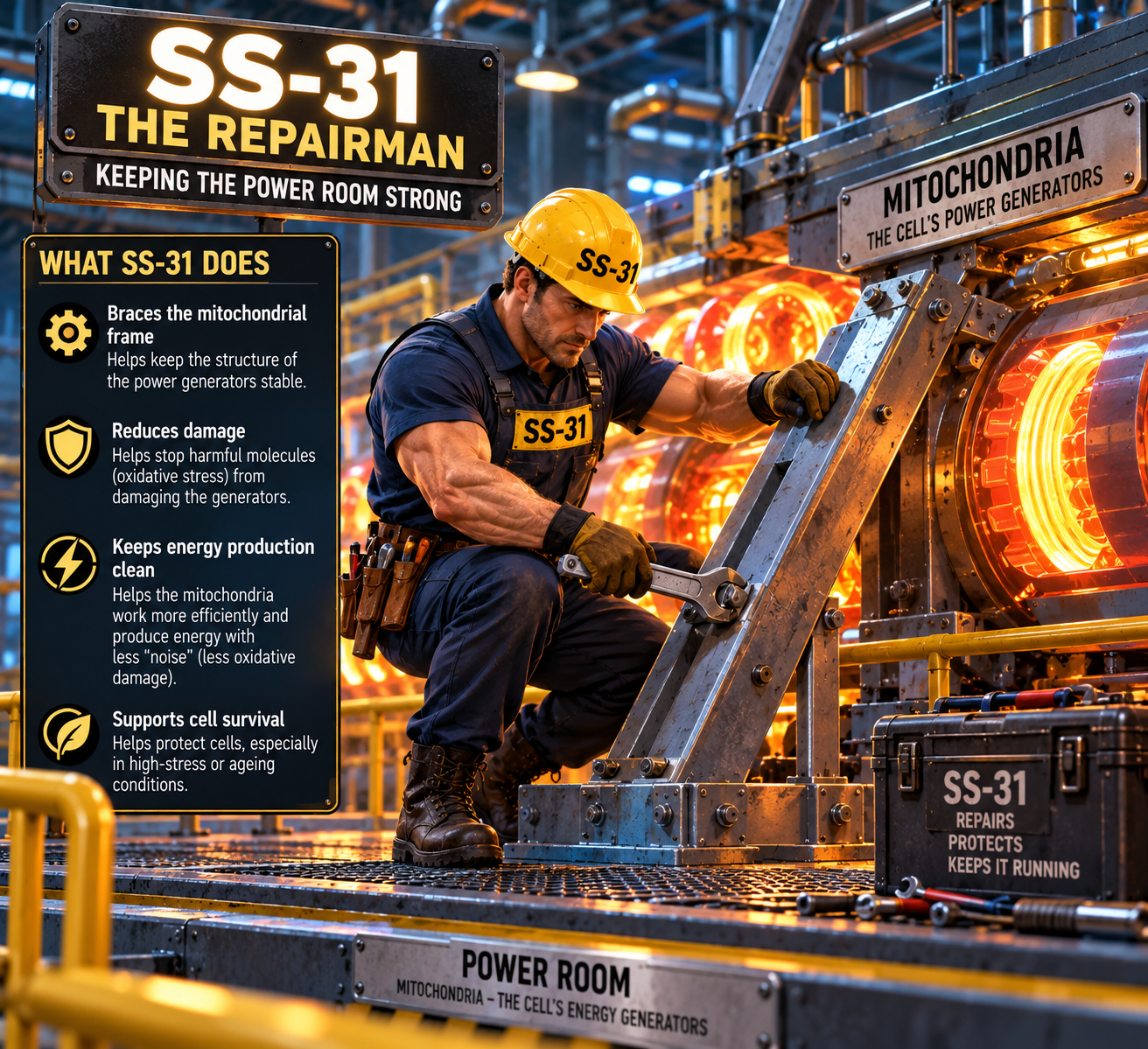
SS-31 is the repairman who braces that frame. He doesn't clean up the sparks after they've flown (that's what a normal antioxidant does, the janitor with a broom). He goes straight to the frame itself and reinforces it. He keeps the generators aligned so fewer sparks fly in the first place. In the lab, that frame has a name: cardiolipin. It's a special fat molecule found almost exclusively on the inner membrane of the mitochondria, the scaffold that keeps the energy-generating machinery organized. When cardiolipin gets damaged, the whole engine room falls out of tune. SS-31 is proposed to bind to it and hold it steady. He's not the flashiest character on the floor. But without him, the power room slowly falls apart. And a factory without power is just a building.
Chapter Two: The Memo That Says "Run Leaner"
MOTS-c
Here's something remarkable. The power room doesn't just sit there waiting for help. It sends messages. MOTS-c is one of those messages. It's a tiny peptide made inside the mitochondria itself, and when the factory is under metabolic stress, or when the "exercise alarm" goes off, the power rooms produce more of it. That message travels to the factory floor and says:
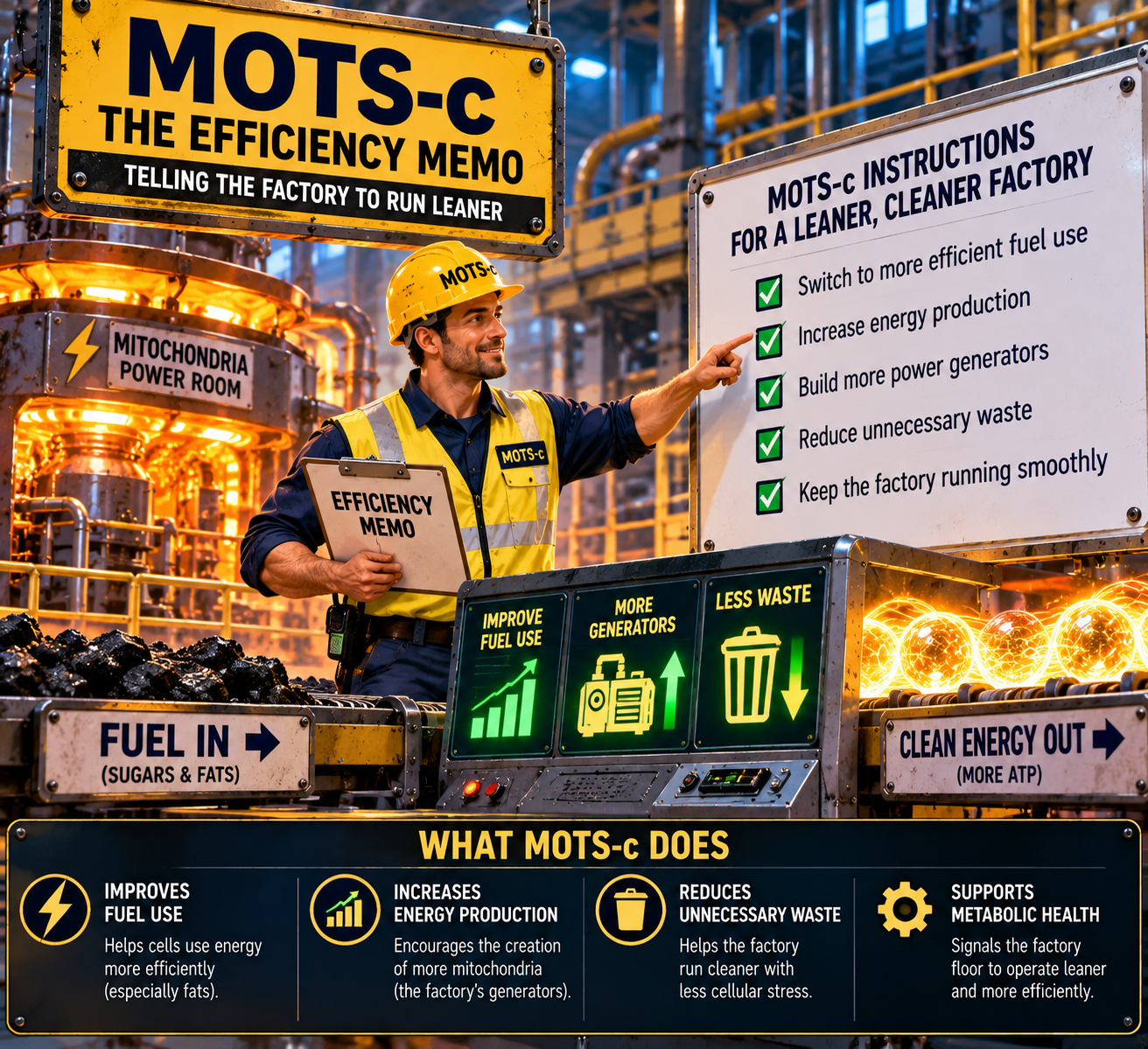
"Tighten up. Switch to leaner fuel. Get more efficient." In the body, this is thought to work through a master energy sensor called AMPK, think of it as the factory's low-fuel warning system that triggers efficiency mode. When MOTS-c sends its memo, the factory pulls glucose out of the bloodstream more effectively, burns fuel more cleanly, and even signals the power rooms to tune themselves up. Researchers call this an "exercise mimetic", a signal that tries to trigger some of the same adaptations exercise does, without the exercise. MOTS-c isn't the fuel. It isn't the repairman. It's the memo. And in a factory that's running inefficiently, a good memo can change everything.
Chapter Three: The Plumber Who Brings the Supplies
BPC-157
When a section of the factory gets damaged, a torn tendon, a strained muscle, an inflamed gut, the first problem isn't the broken machine. It's the supply line. If blood can't reach the damage, nothing gets fixed.
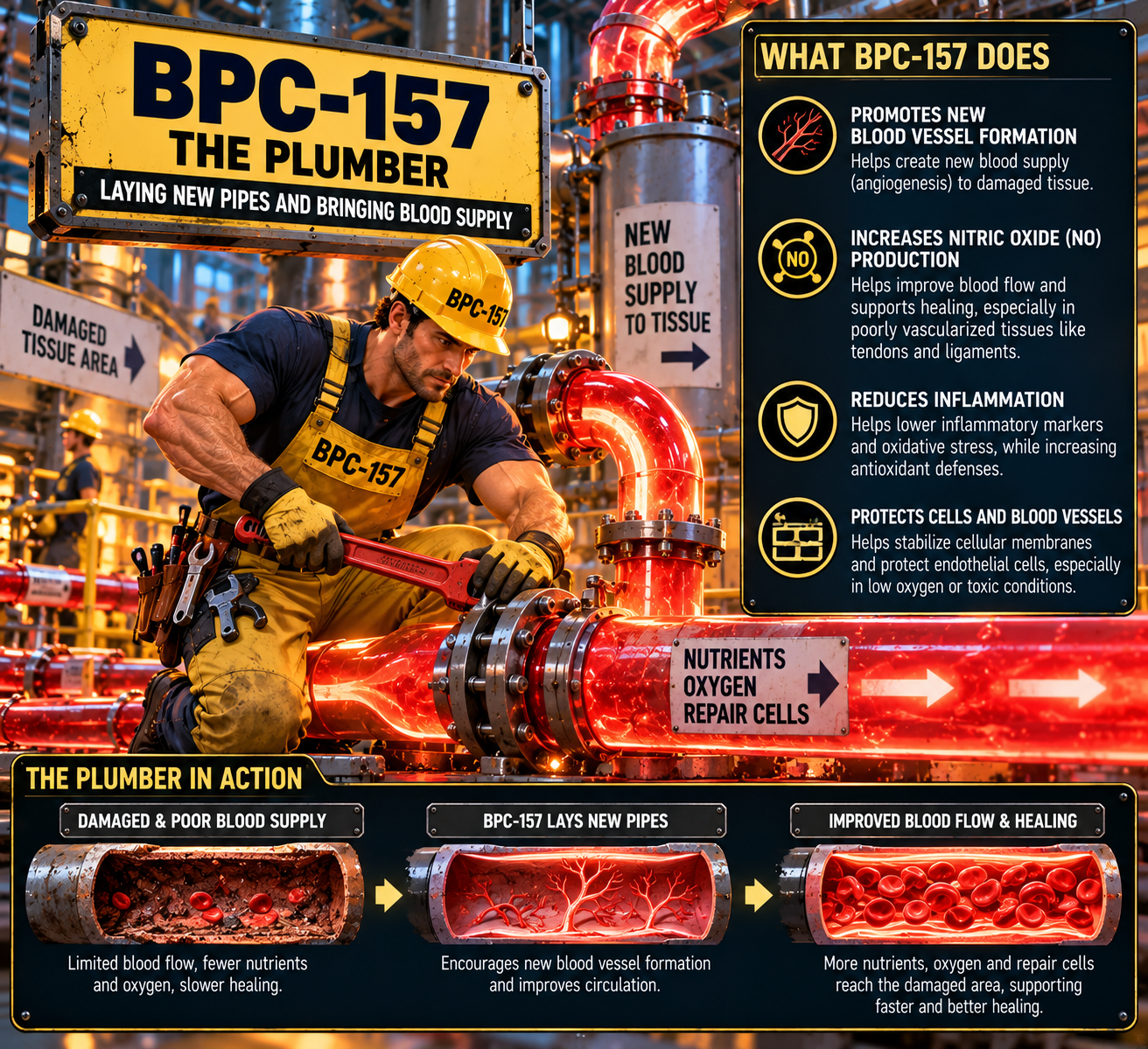
BPC-157 is the plumber. He lays new pipes. He restores the flow. he's proposed to promote angiogenesis, the growth of new blood vessels, so that damaged tissue gets the oxygen and nutrients it needs to heal. He's also the emergency repair crew. He's been observed in rat models to accelerate healing of transected nerves, improve muscle fiber organization after injury, and protect organs like the liver and gut from damage. He doesn't build the walls. He doesn't run the control room. But he makes sure the materials can get to the job site. And in a factory under repair, the plumber is the difference between a fix that works and a fix that stalls.
Chapter Four: The Foreman Who Moves the Crew
TB-500
You've got supplies. You've got a damaged section. Now you need workers.
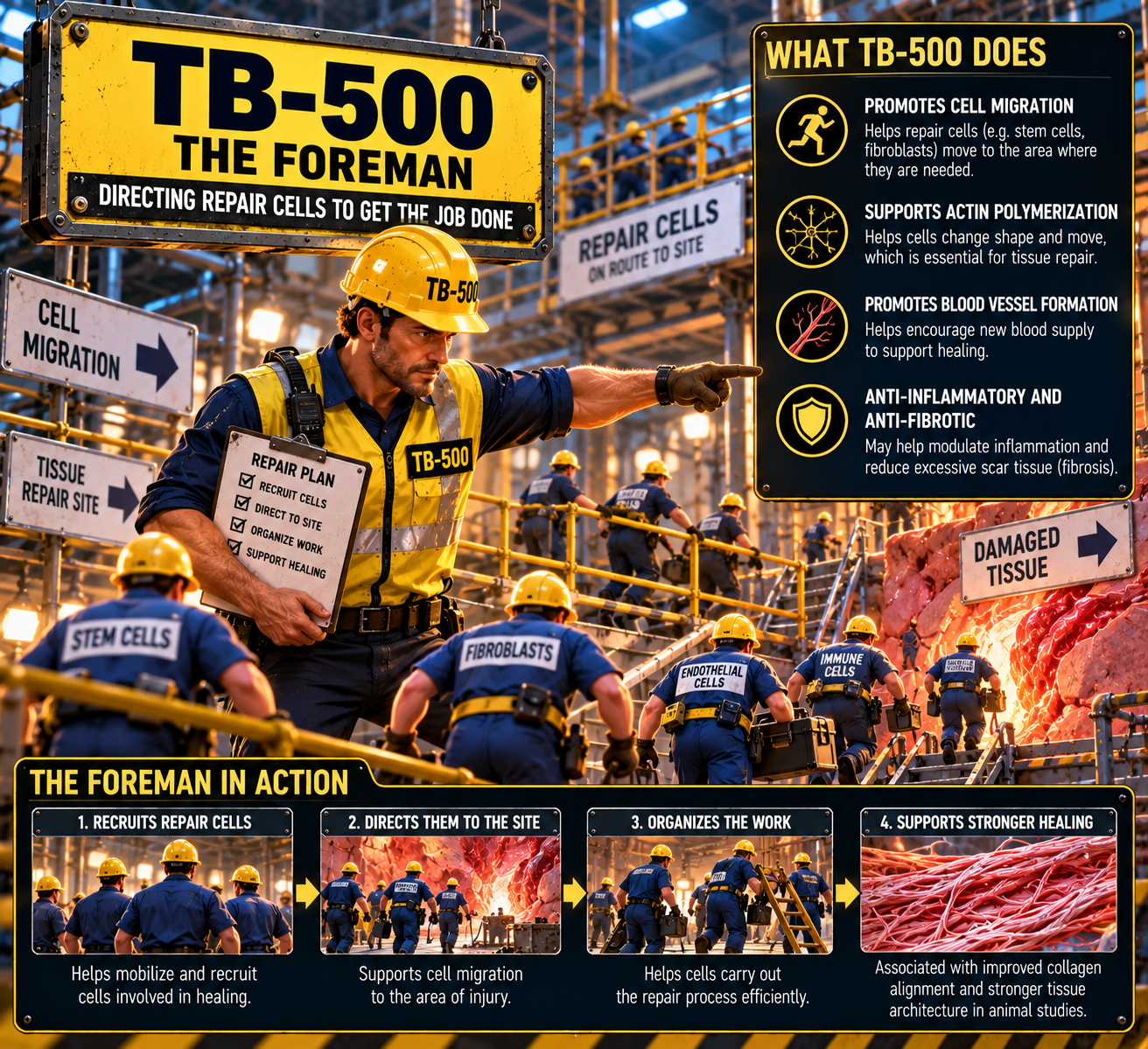
TB-500 is the foreman. His proposed job is to regulate actin, part of the cell's internal skeleton, so that repair cells can move, migrate, and organize themselves at the site of injury. In plain terms: he's the one who says, "You, you, and you, get over to the broken machine and start working." In a 2025 rat study, TB-500 treatment after Achilles tendon rupture resulted in stronger repaired tissue, better collagen alignment, and less pathological scarring compared to controls. That's the foreman doing his job: not building the wall himself, but making sure the crew is in the right place at the right time. He's not the most studied character in the lineup. In fact, most of what we know about his family comes from his bigger brother, the full-length protein. But on the factory floor, his role is clear: movement and coordination.
Chapter Five: The Renovation Crew
GHK-Cu
After the pipes are laid and the workers are in place, someone has to actually rebuild the walls. GHK-Cu is the renovation crew. It's a small copper-binding peptide that the body naturally releases when tissue is broken down. It shows up after damage and gets to work on the structure itself, not the power room, not the pipes, but the building materials.
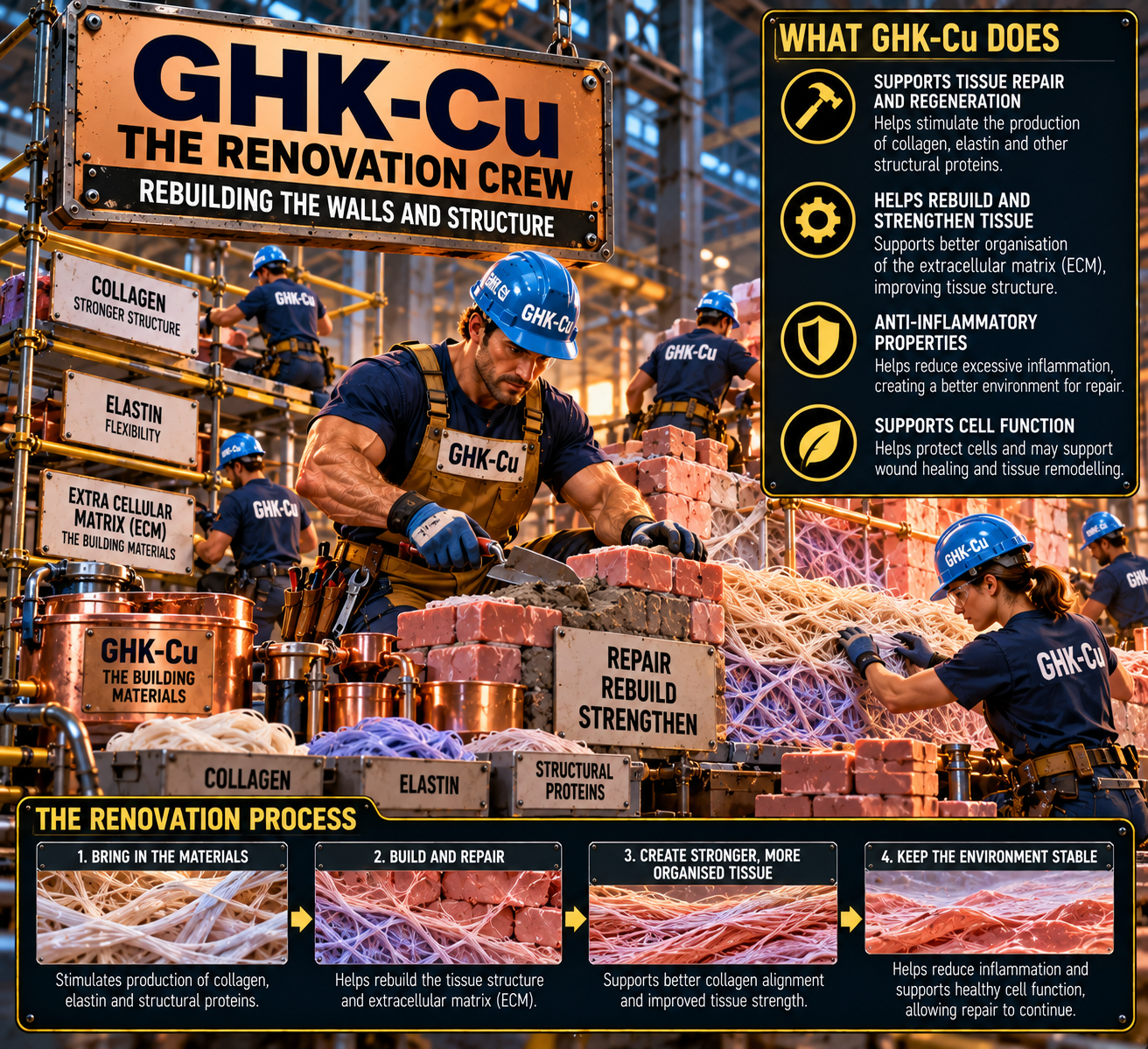
In animal wound models, GHK-Cu has been observed to dose-dependently increase collagen, elastin, and glycosaminoglycans, the proteins that make up the factory's connective tissue. It attracts repair cells like macrophages and fibroblasts, helps them attach and migrate, and turns down the inflammatory alarm so the renovation isn't disrupted by chaos. It even improves the blood supply for the renovation by increasing VEGF and FGF-2, the signals that tell the body to grow new vessels to feed the repair work. GHK-Cu has one of the deepest research histories of any peptide in this story. Decades of pathway mapping. But its human evidence is still mostly cosmetic and small-scale. The renovation crew has a great resume. The question is how much of that translates from the lab to real-world outcomes.
Chapter Six: The Night-Shift Manager
Epitalon
Every worker in the factory carries an instruction manual, their DNA. And every time they divide to make a new worker, a little tag at the end of that manual gets shorter. Those tags are called telomeres. When the tag gets too short, the worker stops dividing and goes into retirement. That's cellular senescence. It's part of aging. Epitalon is the night-shift manager who tries to rebuild those tags. Its proposed mechanism is to activate telomerase, the enzyme that extends telomeres, potentially letting workers keep dividing and staying functional longer.
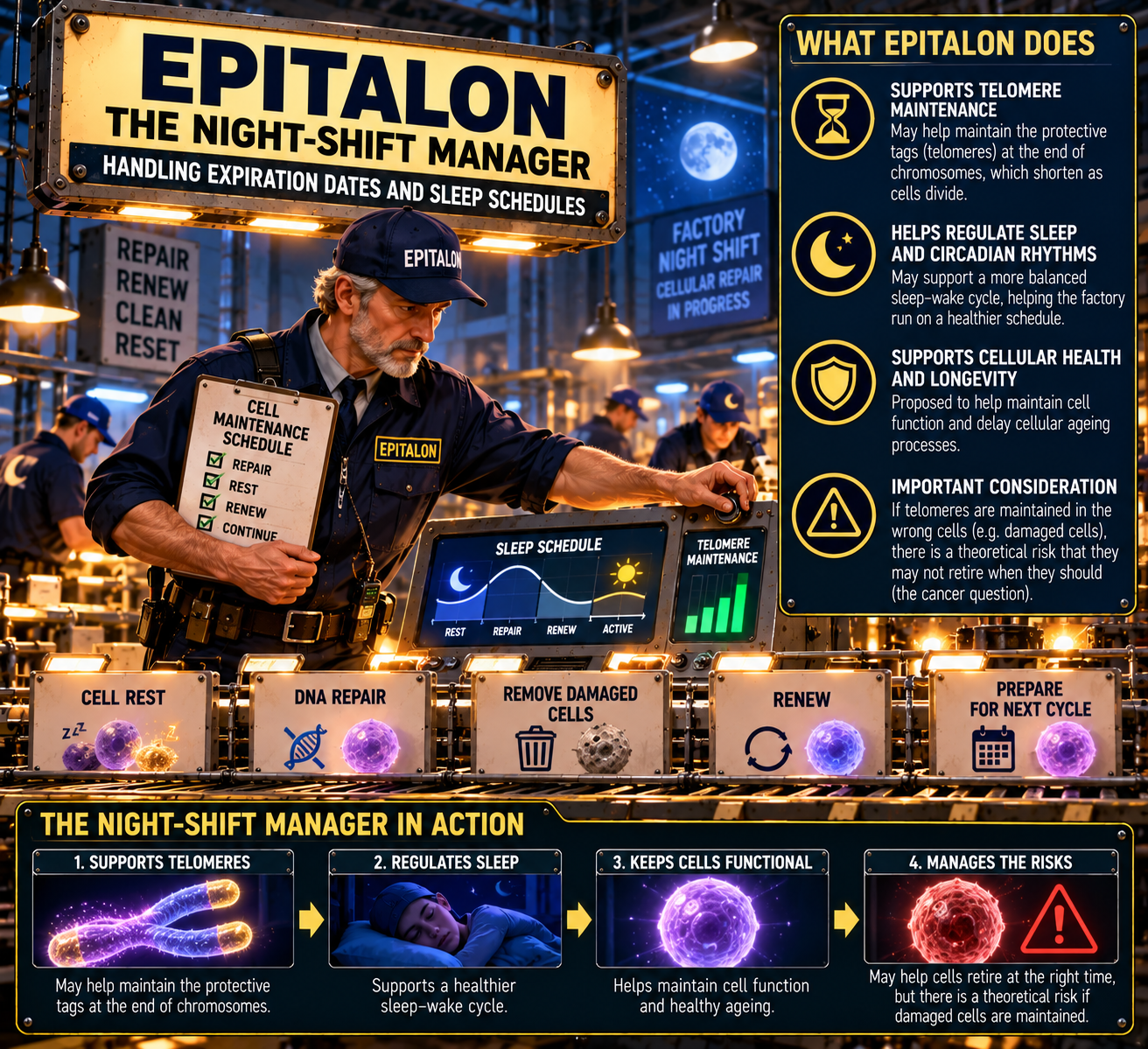
It also seems to act like a manager for the factory's schedule. In aging monkeys, Epitalon helped restore the normal daily rhythm of melatonin and cortisol, essentially trying to get the factory's day/night clock back on track. But this manager carries a risk that the others don't. If telomeres are rebuilt in the wrong cells, damaged workers might never retire. That's the cancer question. And it's unresolved. Epitalon is the most "anti-aging" character in the story and the one with the heaviest caution label.
Chapter Seven: The Officer in the Control Room
Semax
Above the factory floor, there's a control room. The brain. The place where coordination happens. Where learning, memory, adaptation, and resilience are managed. And in that control room, there's an officer. Semax is the training and resilience officer.

His proposed job is to boost BDNF ("brain-derived neurotrophic factor") the fertilizer that helps the control room's wiring strengthen and grow. In rat studies, a single dose increased BDNF protein in the hippocampus (a key memory center) and improved learning. In stroke models, Semax helped reduce inflammation and cell-death signals in brain tissue and supported recovery of neurological function. He also fine-tunes the communication lines, modulating dopamine and serotonin signaling in regions tied to attention and mood. While SS-31 fixes the power room and BPC-157 fixes the pipes, Semax keeps the brain sharp and resilient. And a sharp control room means the whole factory coordinates better. Of all the brain peptides, Semax has the best human evidence. He's the most proven of the brain-focused crew.
Lew
(with Ai assisted research and illustrations.)