Epitalon: Telomeres, Sleep and the Search for Healthy Ageing
A four-amino-acid peptide has sparked some very big questions. Could it influence the way cells age, and what do the studies and personal experiences actually tell us?
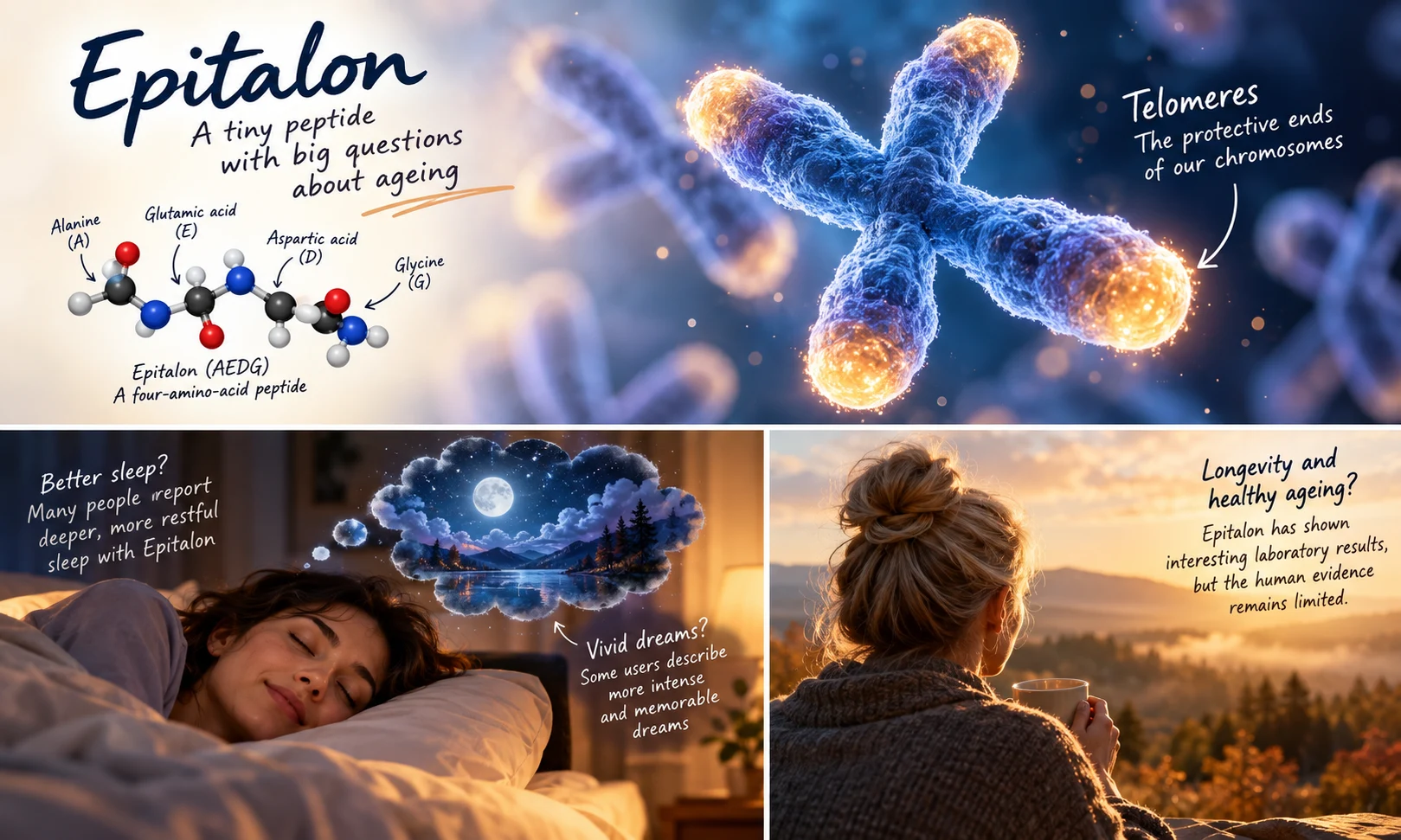
AI-generated editorial illustration. The molecular model is stylised, not a verified chemical structure. Images illustrate research questions and reported experiences, not established benefits.
What is Epitalon?
Epitalon, sometimes spelt Epithalon, is a synthetic peptide made from four amino acids: alanine, glutamic acid, aspartic acid and glycine. Scientists call this sequence AEDG.
Its story is closely associated with research by Vladimir Khavinson and colleagues into short peptides, biological regulation and ageing. Unlike a licensed medicine with a well-established clinical use, Epitalon is primarily a subject of experimental investigation.
Why are people so interested?
Ask about Epitalon in a longevity discussion and three subjects quickly appear: telomeres, sleep and lifespan. Some people hope that influencing the cellular machinery associated with ageing could eventually help maintain health later in life. Others are drawn to accounts of changes in sleep patterns or unusually vivid dreams.
These are reasons for curiosity, not established outcomes. In particular, a laboratory effect on a cellular marker is not the same thing as a demonstrated improvement in human health.
Telomeres: why chromosome ends matter
Telomeres are protective structures at the ends of chromosomes. They help prevent chromosome ends from being mistaken for damaged DNA. In many cell types, telomeres shorten as cells divide, although the relationship between telomere length, cellular ageing and whole-body ageing is complicated.
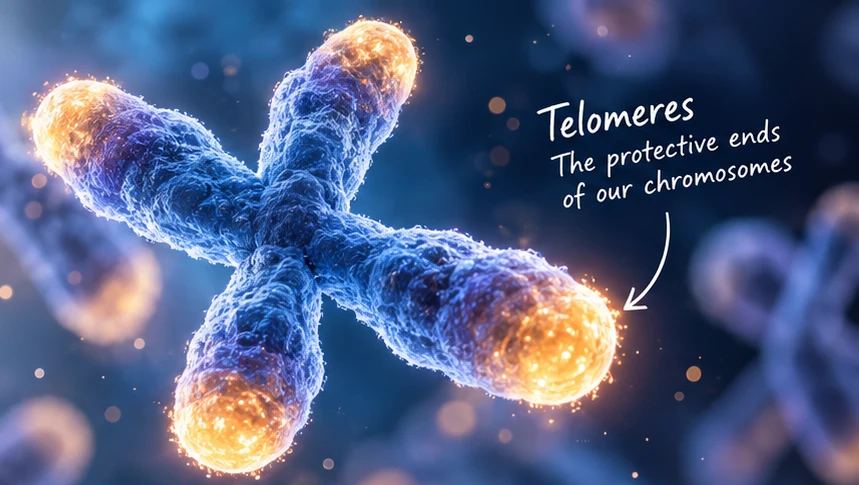
An enzyme called telomerase can help maintain telomeres in certain circumstances. That makes telomerase interesting to ageing researchers, but also relevant to cancer biology, since many cancers use telomere-maintenance mechanisms to keep dividing.
So the question is not simply whether a substance can affect telomeres. Researchers also need to establish what that change means for health and long-term safety.
What did the laboratory studies find?
A 2003 paper by Khavinson and colleagues reported telomerase activity and telomere elongation in cultured human somatic cells exposed to Epitalon. A subsequent study examined further cell-division effects. These findings helped generate scientific interest in the peptide.
What the studies did not establish: that Epitalon reverses ageing in people, prevents age-related disease or extends human lifespan. Cultured cells are an important starting point, but they cannot reproduce the complexity of an entire person.
Experimental findings should also be interpreted in the context of study methods, replication and the need for independent confirmation.
What do human studies actually show?
Human evidence is much thinner than the online excitement might suggest. Small investigations have explored biological or circadian measurements, while other older clinical claims involve Epithalamin rather than synthetic Epitalon. These preparations need to be assessed separately.
There is no convincing large, adequately controlled human trial demonstrating that Epitalon extends life, reverses biological ageing or produces a reliable clinical improvement in sleep. A change in a laboratory biomarker, even in humans, would not by itself prove those outcomes.
For readers interested in the technical literature, the most useful questions are whether a study used the defined AEDG peptide, how participants were selected, whether there was a suitable control group, what was actually measured and whether results were independently reproduced.
What about sleep, melatonin and body clocks?
Epitalon is sometimes discussed alongside the pineal gland and melatonin, a hormone involved in regulating daily sleep-wake rhythms. That connection has inspired interest in whether Epitalon might influence circadian biology.
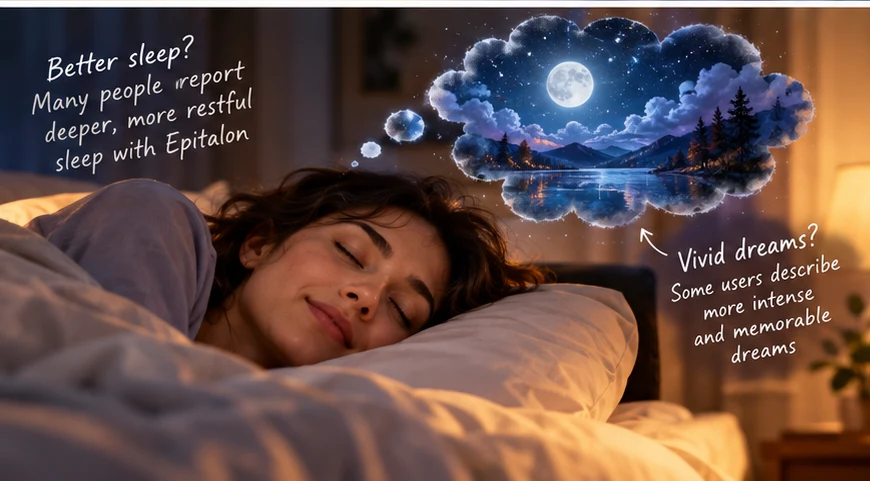
Some preliminary research and personal accounts have focused on sleep timing or dream experiences. But we do not yet have the kind of well-controlled clinical evidence needed to say that Epitalon reliably improves insomnia, sleep quality or melatonin regulation.
For a different research topic linked to cellular energy and ageing, see our MOTS-c guide. The mechanisms and evidence are different.
What are people reporting online?
Many public discussions centre on sleep rather than lifespan. Some contributors describe more regular sleep, earlier waking or vivid dreams. Others describe no clear effect or disrupted sleep. Such reports are useful for understanding why the subject attracts attention, but their causes cannot be verified from anonymous posts.
People may also change their caffeine intake, routines or other substances at the same time. The identity and quality of any product mentioned online are generally unknown. We therefore treat these accounts as unverified experiences, not clinical evidence.
Safety, uncertainty and UK status
Long-term human safety is not established. Questions remain about unwanted reactions, immune effects, interactions, exposure over time and the consequences of influencing cell-division pathways. Telomerase's role in cancer biology is a reason for careful research, not evidence that Epitalon itself causes cancer.
Epitalon should not be described as a licensed anti-ageing or insomnia treatment in the UK. Any specific medicinal licensing or advertising claims should be checked against current MHRA requirements before publication. Products advertised online as research substances cannot be assumed to have pharmaceutical-grade identity, purity or safety.
Peptide Cafe does not sell peptides, recommend suppliers or encourage self-experimentation.

Guinea Pig Gary Has His Say ☕🐹
Real conversations, told with enthusiasm.
Now THIS is a subject that gets my whiskers twitching! When I looked through Epitalon discussions, what excited me most wasn't someone claiming to have found eternal youth. It was people talking about something wonderfully ordinary: a good night's sleep.
One Reddit contributor described struggling with early waking after giving up caffeine and said their sleep became more regular after using Epitalon. Another person, posting in an insomnia community, described a striking improvement in their sleep schedule. And in a separate discussion, someone talked about especially vivid, memorable dreams.
Can you imagine how encouraging a better night's rest might feel to somebody who's been struggling? Those are the voices I want to make sure we hear at our café table! I love that people are sharing hopeful experiences, even while the researchers continue to work out what Epitalon really does.
Not everyone reports a benefit, and these stories cannot tell us what caused the changes. I'm a fictional café commentator, not someone who took Epitalon. But positive experiences are part of the conversation, and they deserve to be reported accurately.
These are self-reported, independently unverified online accounts. Their links are supplied for transparency, not as an endorsement of products or methods. Editorial review should confirm the posts remain accessible and are characterised accurately.
☕ The Peptide Cafe Perspective
Why we're fascinated by Epitalon, without confusing possibility with proof.
Four amino acids. That's all it takes to make Epitalon. Yet the questions surrounding this tiny molecule stretch across some of the most intriguing areas of modern biology: chromosome protection, cellular ageing, biological rhythms and the hope of remaining healthier for longer.
We think that is worth being excited about.
The discovery that caught our attention
The early cell-culture findings on telomerase are the sort of results that make researchers look twice. They offer a testable idea about how a small peptide might interact with the machinery of living cells.
But a testable idea is not a proven therapy. The challenge now is to determine whether those effects can be reproduced, whether they matter in real human bodies and whether they can be investigated safely.
Why we want to hear the sleep stories
Longevity is difficult to measure in everyday life. Sleep, on the other hand, is something people notice tonight and tomorrow morning. That helps explain why so many public accounts focus on rest, routines and dreams.
We welcome those stories. They are not a substitute for a clinical trial, but they reveal the hopes and experiences that make people curious about the science.
Where we'd love research to go next
Four questions worth following
- Telomere biology: Can independent groups reproduce the laboratory findings?
- Human outcomes: Do controlled studies show any meaningful benefit beyond biomarkers?
- Sleep: Are the reported changes measurable and repeatable?
- Long-term safety: What happens when people are followed carefully over time?
Our verdict?
Epitalon is a compelling research story, not a proven shortcut to longevity. The laboratory science deserves curiosity, the positive personal accounts deserve a fair hearing, and the unanswered questions deserve just as much attention.
That balance is what makes the conversation worthwhile.
Science, experiences, claims and curiosity are all welcome in the Peptide Cafe.
References and further reading
- Khavinson VK, Bondarev IE, Butyugov AA. Epithalon peptide induces telomerase activity and telomere elongation in human somatic cells. Bulletin of Experimental Biology and Medicine (2003). PubMed record.
- Jain A, et al. Epitalon and Epithalamin: A Narrative Review of Mechanistic, Preclinical, and Clinical Evidence. International Journal of Molecular Sciences (2026). Review DOI. Check bibliographic details and interpretation before publication.
- Public report describing worse sleep. Unverified personal account.
Educational information only. This article is not medical advice. See the site's editorial and medical disclaimer.