What is TB-500?
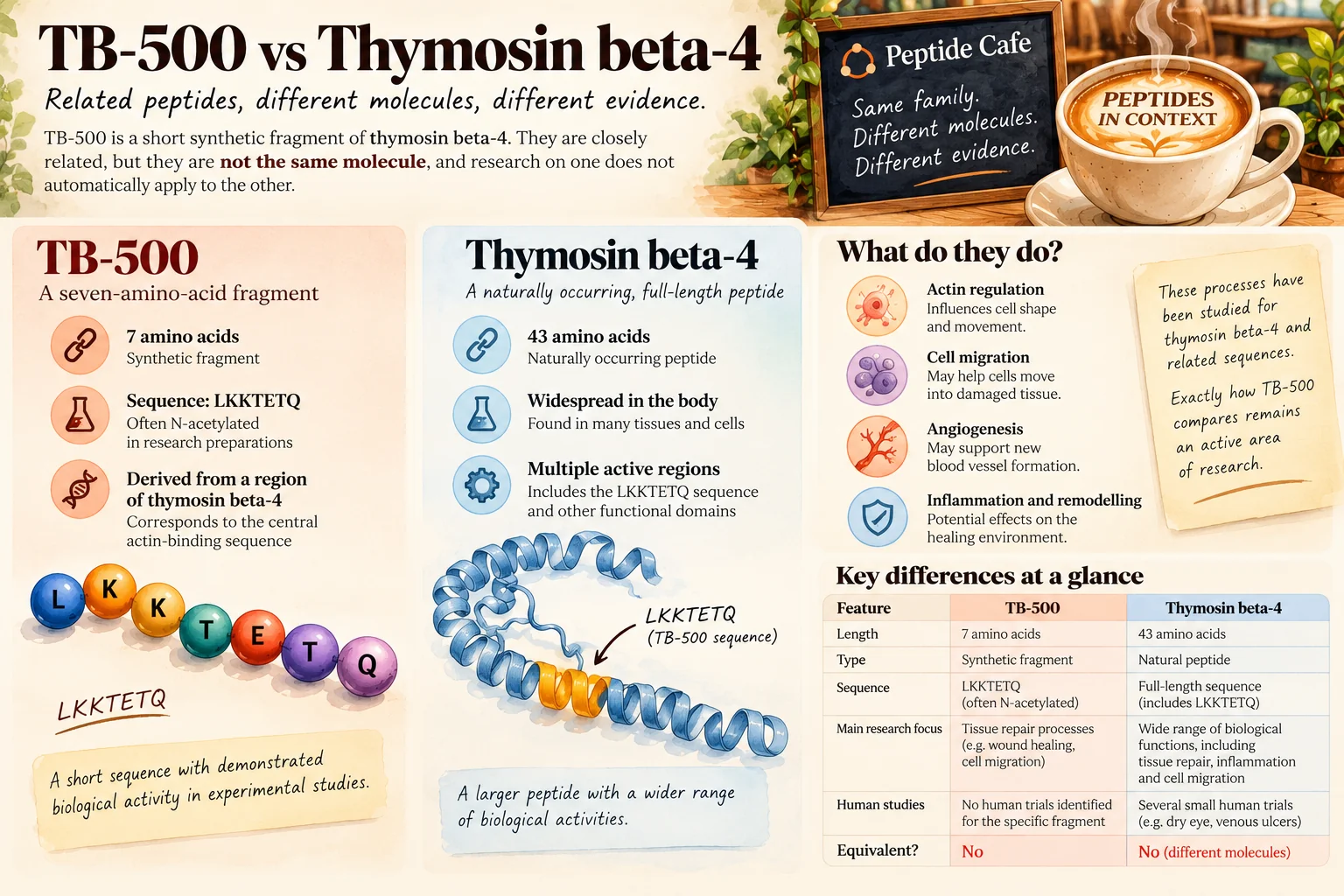
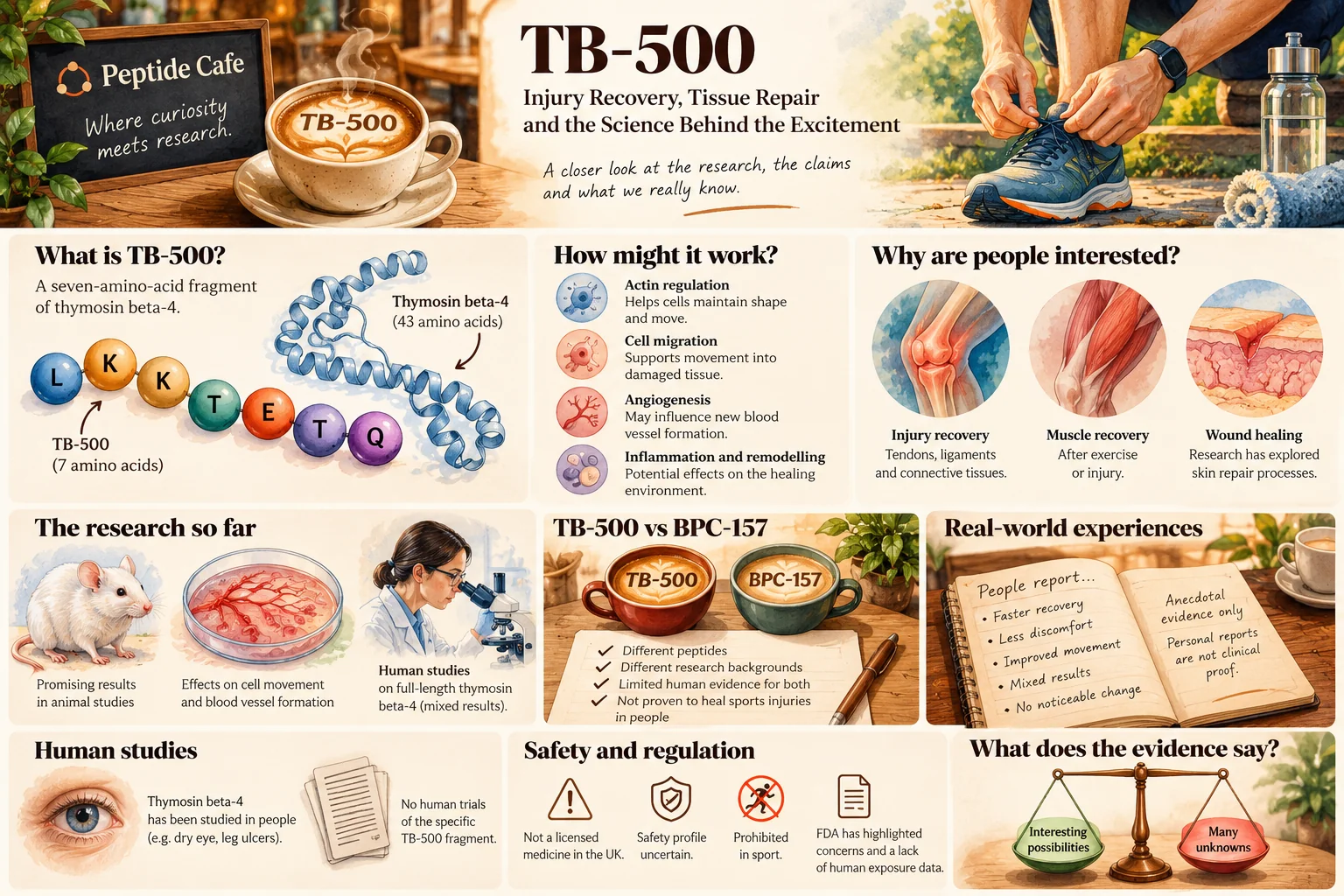
TB-500 is a synthetic seven-amino-acid peptide fragment associated with thymosin beta-4, a naturally occurring peptide containing 43 amino acids. In the FDA’s 2026 assessment, TB-500 is identified as N-acetyl-LKKTETQ, a chemically modified version of a seven-amino-acid sequence found within thymosin beta-4.
Thymosin beta-4 is involved in the regulation of actin, a protein that helps cells maintain their shape and move. That makes it interesting to scientists studying how tissues repair themselves.
Why are people interested?
The big talking points are tendon and ligament recovery, muscle repair, wound healing and exercise recovery. People are understandably curious about whether a small peptide could influence the body’s natural repair processes.
Those ideas come from a mixture of biological hypotheses, early experiments on related peptides and personal claims online. They are not proven clinical benefits of TB-500.
How might it work?
Scientists have investigated how thymosin beta-4 and related sequences affect cell movement, actin regulation and angiogenesis, the development of new blood vessels. All can matter in wound repair. Some studies also explore inflammatory signalling and tissue remodelling.
But a plausible mechanism is only a starting point. It does not tell us whether TB-500 improves a real injury, how large any effect might be or what risks it could carry.
What laboratory and animal studies actually found
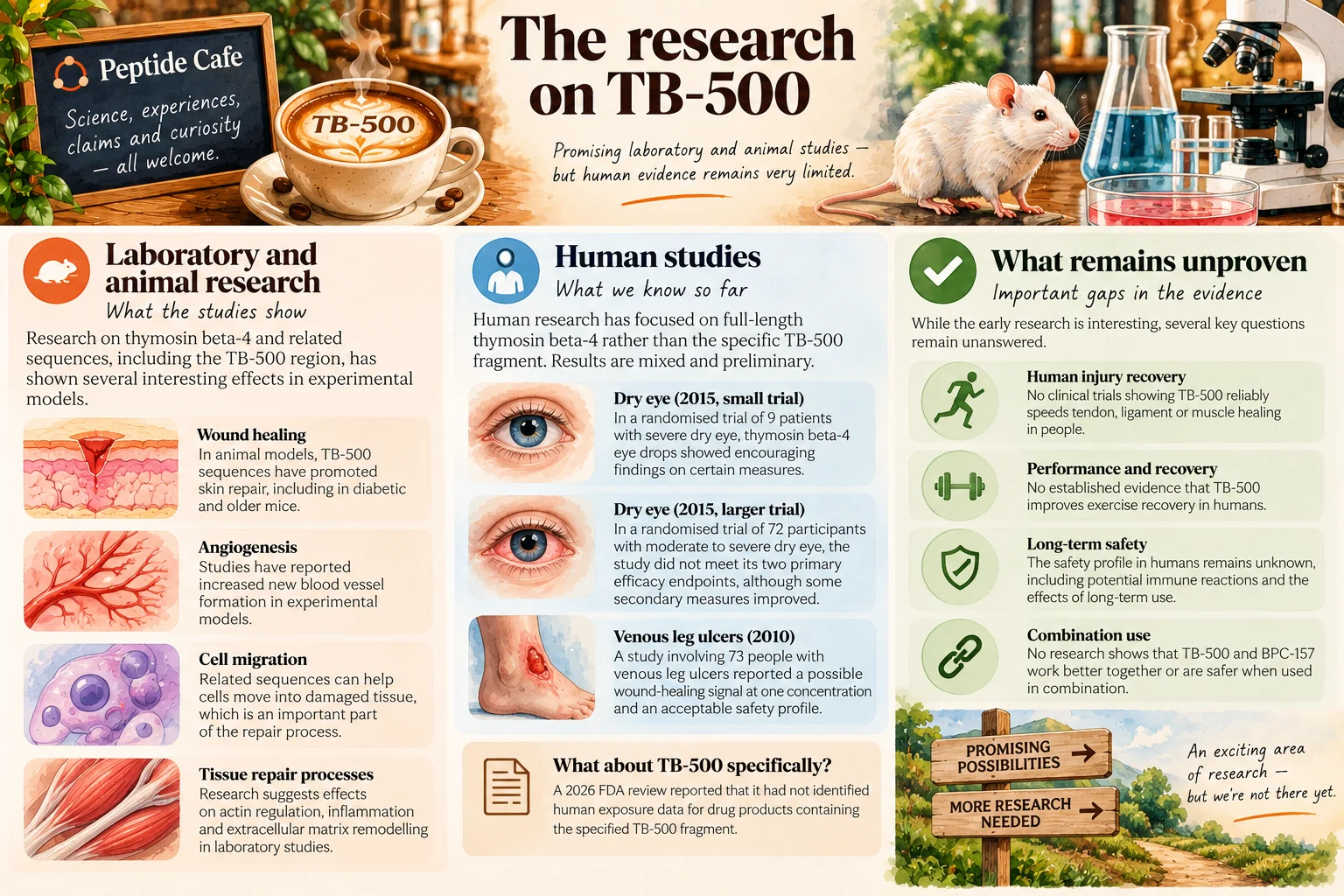
In a 2003 study by Philp and colleagues, full-length thymosin beta-4 improved measures of skin wound repair in diabetic and aged mice. The researchers also tested the unmodified LKKTETQ sequence, which promoted repair in aged animals.
A separate 2003 experimental study examined the actin-binding region of thymosin beta-4 in cell migration and blood-vessel formation models.
These findings help explain the interest in the fragment. They do not demonstrate that N-acetylated TB-500 repairs human tendons or muscles. In its 2026 review, the FDA reported that it did not identify published in-vivo nonclinical wound studies specifically assessing TB-500.
Has TB-500 been tested in humans?
There have been human trials involving full-length thymosin beta-4, including eye-drop studies for dry eye and a topical study of venous leg ulcers. These are not clinical trials of TB-500 injections for sports injuries.
For example, a small 2015 severe dry-eye trial reported encouraging findings in nine participants. Another 2015 randomised trial involving 72 participants did not meet its primary efficacy endpoints, although some secondary outcomes suggested possible activity.
A venous leg ulcer study investigated topical thymosin beta-4 and reported a potential healing signal at one concentration. These are preliminary, condition-specific findings for the full-length peptide.
Around the Café: what people report
In peptide discussions, people describe hopes of faster injury recovery, reduced discomfort and better movement. Others say they noticed little change or are unsure whether improvement came from time, rehabilitation or something else.
These are themes of online discussion, not verified clinical outcomes. We are deliberately not inventing quotes or presenting composite stories as real testimonials. A future update can add a balanced set of traceable public accounts with appropriate context and privacy care.
Anecdotes can help us understand what people are curious about. They cannot establish cause and effect.
TB-500 vs BPC-157
The two peptides are often mentioned together in conversations about injury recovery, but they are chemically distinct and have different research histories. Neither YET been established as a treatment for sports injuries in humans.
| Question | TB-500 | BPC-157 |
|---|---|---|
| What is it? | Seven-amino-acid synthetic fragment associated with thymosin beta-4 | 15-amino-acid synthetic peptide |
| Main interest | Cell movement and repair-related pathways | Tissue-repair hypotheses studied mainly in animals |
| Human injury-recovery proof | Not established | Not established |
| UK licensed medicine? | No | No |
There is no reliable clinical evidence that combining them works better or is safer. For a deeper look, visit our BPC-157 guide.
Safety, UK regulation and sport
TB-500 is not a licensed medicine in the UK. Its human safety profile is poorly characterised. Important unknowns include adverse effects, immune reactions, product impurities and long-term consequences.
The FDA’s 2026 assessment raises questions about the available safety and exposure data for the specified fragment. These concerns should not be confused with safety findings from small trials of full-length thymosin beta-4 used in different ways.
Thymosin beta-4 and its derivatives, including TB-500, are prohibited in sport under anti-doping rules. Online descriptions such as “research peptide” do not mean a product has been authorised for human use.
What does the evidence say?
| Claim | Our assessment |
|---|---|
| Full-length thymosin beta-4 affects repair-related biology | Preclinical support |
| Unmodified LKKTETQ promotes skin repair in aged mice | Animal evidence |
| Full-length thymosin beta-4 has been tested in people | Small, mixed human trials |
| TB-500 speeds human tendon or muscle healing | Not established |
| TB-500 and BPC-157 work better together | Not established |
| Long-term TB-500 use is safe | Unknown |

Guinea Pig Gary Has His Say 🐹☕
Real conversations, told with enthusiasm.
Now HERE'S the other side of the conversation, the voices of people who are genuinely thrilled with how their recovery has gone! I think those stories deserve a proper seat at our table.
In one public recovery discussion, a commenter described Achilles surgery rehabilitation and said using a combination including BPC-157 and TB-500 had been a huge help. They described returning to walking and progressively demanding physiotherapy, and reported that their therapist thought their progress was ahead of schedule. That enthusiasm is hard not to understand when the goal is simply getting moving again!
Another public account described a difficult leg problem followed by better walking and steady gains in physical therapy; that writer said TB-500 was added later alongside BPC-157. A separate commenter discussing tendon trouble described perceived relief after using the two together. Those are real, positive accounts, but they're not TB-500-only experiments, and ongoing rehabilitation, time and other interventions all matter.
I'd love to hear more well-documented outcomes like these. Until then, I'm delighted to bring you the enthusiastic voices themselves rather than pretend the community has nothing interesting to say. That's the Guinea Pig Gary view: listen to the experiences, celebrate the progress people report, and never invent a result.
- Reddit: Achilles rehabilitation and combined-peptide account
- Reddit: long-term rehabilitation account
- Reddit: experiences with BPC-157 and TB-500
Guinea Pig Gary is a fictional editorial character, not a person who used these substances. The linked posts are self-reported experiences, not verified testimonials or clinical evidence. References here do not endorse the products, suppliers or methods discussed in those posts.
☕ The Peptide Cafe Perspective
A fascinating peptide story with plenty to be excited about.
We think TB-500 is a genuinely fascinating subject, and it's easy to understand why it has captured the imagination of people interested in recovery, healing and the body's remarkable ability to repair itself.
The idea that a small fragment of a naturally occurring peptide might influence biological processes involved in tissue repair is intriguing. Research into thymosin beta-4 and its related sequences has revealed interesting connections with cell movement, blood-vessel formation and wound-healing biology.
These aren't insignificant scientific questions. They're fundamental processes involved in how living tissues respond to injury, and investigating them could contribute to our understanding of recovery and regeneration.
Why we're particularly excited
One of the most encouraging aspects of this research is that scientists have observed favourable wound-repair findings in animal experiments involving full-length thymosin beta-4 and its unmodified LKKTETQ sequence.
Some human trials of full-length thymosin beta-4 have also produced encouraging signals in specific conditions, although the results have been mixed.
We find this combination of laboratory investigation, animal research and early clinical exploration particularly interesting. It shows how a biological idea can gradually develop into a serious scientific question.
Importantly, those findings are not proof that the modified TB-500 fragment accelerates human injury recovery. The distinction matters, but it doesn't diminish the fascination of the broader research.
And then there are the experiences people share...
Away from research laboratories, TB-500 has inspired enthusiastic conversations about stubborn injuries, difficult recovery periods and the hope of returning to normal activities.
Some people discussing peptides online describe improvements in comfort, movement or recovery that they associate with TB-500. Others describe uncertain outcomes or no noticeable improvement.
We think these conversations are worth exploring. Behind many of them are people who simply want to recover, feel better and get back to doing what they love.
Those accounts aren't controlled clinical evidence, and we cannot reliably determine whether TB-500 caused the improvements described. But they reveal the questions people care about and the outcomes future research could investigate.
Imagine what better research could tell us
We'd love to see carefully designed human trials investigate whether the specific TB-500 fragment influences tendon, ligament or muscle recovery.
Could researchers identify measurable benefits? Might certain conditions respond differently? Could the encouraging biological findings translate into useful clinical discoveries?
We don't know the answers yet. And for us, that's one of the most exciting things about scientific research: the possibility of discovering something genuinely new.
✨ What makes TB-500 worth watching?
- Fascinating repair biologyResearch on related peptides has uncovered interesting effects on biological processes involved in tissue repair.
- Enthusiastic community interestReported positive experiences raise questions that deserve proper scientific investigation.
- Exciting opportunities for future researchHuman trials could establish whether any of the proposed benefits are real, meaningful and safe.
Our verdict? TB-500 is a compelling research story with interesting biology, passionate discussion and important unanswered questions. We're enthusiastic about exploring those possibilities and even more excited about the discoveries that good research could bring.
Science, experiences, claims and curiosity are all welcome at the Peptide Cafe. ☕
Original research and further reading
- Philp et al. (2003). Thymosin beta-4 and a synthetic peptide containing its actin-binding domain promote dermal wound repair in diabetic and aged mice.
- Philp et al. (2003). The actin binding site on thymosin beta-4 promotes angiogenesis.
- Philp et al. (2010). Biological activities of thymosin beta-4 defined by active sites in short peptide sequences.
- Sosne et al. (2015). Severe dry-eye trial of full-length thymosin beta-4.
- Sosne and Ousler (2015). Randomised trial of thymosin beta-4 ophthalmic solution.
- Venous leg ulcer study (2010). Topical thymosin beta-4.
- US FDA (2026). Scientific assessment of thymosin beta-4 fragment (TB-500).
- World Anti-Doping Agency. Current prohibited list (check applicable edition).